2025 AIChE Annual Meeting
Sr2MnO4 As a Reactive CO2 Sorbent for Sorption-Enhanced Steam Reforming of Biogas to Green Hydrogen
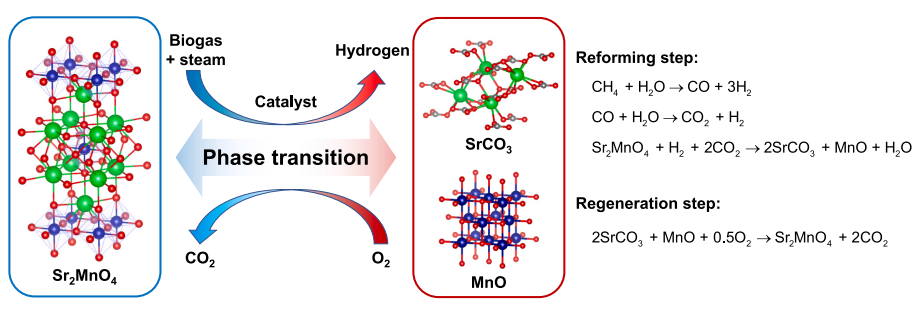
Sr2MnO4 was synthesized via a solid-state reaction and characterized using X-ray diffraction, scanning electron microscopy, and N2 physisorption analysis. The Sr2MnO4 sorbents exhibited a CO2 sorption capacity of over 26 g per 100 g of sorbents, along with excellent cyclic stability in thermogravimetric analysis. Complete regeneration of the sorbent was achieved with a relatively small temperature swing (100°C) between carbonation and decarbonation. Structural analyses revealed that minor secondary phases (SrMnO3 and SrO) formed without degrading overall stability.
Fixed-bed reactor experiments further demonstrated the application of Sr2MnO4 sorbents in SESR of biogas. Biogas simulants with varying CO2 contents were converted to ~94 vol% H2 before CO2 breakthrough, with >98% CH4 conversion. Stable CO2 capacity and hydrogen production were maintained over 20 cycles. In addition, optimization of the regeneration duration enabled the generation of highly pure CO2 and more efficient use of O2. This optimization demonstrates that H2 and CO2 can be coproduced in separable, pure streams suitable for sequestration or downstream use. A life-cycle assessment indicated that integrating this process with CO2 sequestration can achieve net-negative emissions, with a global warming potential of −1.4 kg CO2,eq per kg H2 produced.
These results demonstrate the feasibility of biogas-to-hydrogen conversion with net-negative carbon emissions through integration with CO2 capture and sequestration. In addition, Ruddlesden–Popper oxides are shown to be a promising new class of high-performance, redox-activated sorbents for this process. Together, these findings advance the design of reactive CO2 sorbents and support scalable pathways for decarbonized fuel production from renewable biogas.