2025 AIChE Annual Meeting
(37b) Spectroscopic Monitoring for Fault Detection in Nuclear-Waste Processing
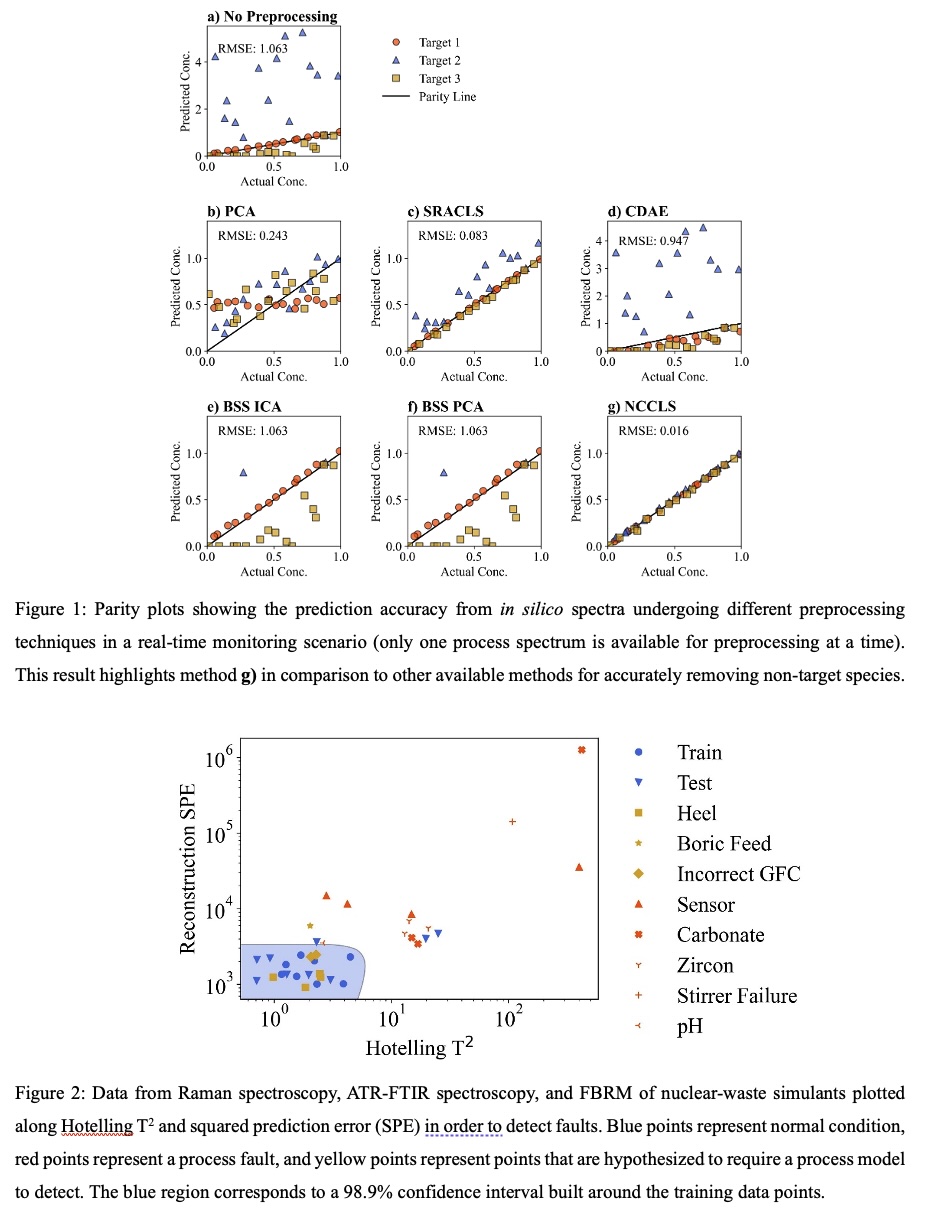
To address the highly multicomponent nature of nuclear waste and the resulting convoluted spectra, two techniques have been developed that will be discussed in this work: nonnegatively constrained classical least squares (NCCLS) [3] and a constrained blind source separation (BSS) method [4]. A situation often encountered when applying spectroscopy to continuous monitoring tasks, including outside of the nuclear domain, is that non-target species (unknown species, adulterants, etc.) can disrupt data-driven quantification of target species (key species, active pharmaceutical ingredients, etc.) The disruptive behavior of non-target species can lead to poor model robustness and prediction errors, which can lead to misinformed or delayed process decisions. Methods exist for identifying and removing additional sources of variation that are not included in calibration data. However, existing methods either require estimates of the pure-component spectra of unknown species or rely on multiple time-series measurements to be effective, preventing real-time spectral analysis using existing methods. NCCLS avoids the requirement of time-series data and the need for pure-component spectra of unknown species, while still proving effective in the case of poorly resolved or overlapping peaks (shown in Figure 1). A competing method, BSS, has been developed to leverage known spectral information to better remove non-target species from spectra in case study of waste at the Savannah River Site.
Limited sensor accuracy during non-standard operating conditions may occur as the result of sensors that are reliant on data-driven models to quantify sensor measurements. To address this issue of sensors that are potentially vulnerable to process upsets, a fault detection strategy is required that can detect when sensor measurements may be compromised. Whereas prior published research has focused on enabling the use of spectroscopy instruments in real-time for monitoring waste, it is still an open question on how to use as suite of instruments in a robust way to detect process, sensor, and waste faults. Therefore, the present research includes currently unpublished work on detecting faults using Raman spectroscopy, ATR-FTIR spectroscopy, and an FBRM instrument. Recent research has used the classical systems analysis techniques of Hotelling T2 and squared prediction error as statistical metrics to detect data-driven faults (shown in Figure 2). These results show that many categories of process faults are observable through data-driven statistics such as these. However, some faults, such incorrect glass-forming chemical addition and changing heel masses, would require a process model in addition to the aforementioned data-driven statistics to be detected as faults.
Vitrification of nuclear waste at the Hanford site is a large undertaking that will take decades and a hundreds of billions of dollars. Because of the substantial investment of capital and time, effective and fault-free waste processing is highly desirable. Accurate and real-time knowledge of the Hanford process may help maintain process control when the feed stream varies with time. The timely detection of faults, possibly before faults impact processing, may aid the vitrification facility in avoiding downtime due to glass-incompatible compositions, damaged equipment, or process upsets. The results of this work may aid in timely and accurate process monitoring at the Hanford site.
References
[1] R. J. Lascola and M. E. Stone, “Real-Time , In-Line Monitoring for High Level Waste Applications,” Aiken, SC, SRNL-RP-2023-01064, Rev. 0, 2023.
[2] M. E. Stone, “Evaluation of a Material Balance Only and Material Balance with Real-Time In-line Monitoring Approaches for DFLAW Processing,” Aiken, 2019.
[3] S. H. Crouse, R. W. Rousseau, and M. A. Grover, “A feature selection method for overlapping peaks in vibrational spectroscopy using nonnegatively constrained classical least squares,” Computers and Chemical Engineering, vol. 189, no. July, p. 108785, 2024, doi: 10.1016/j.compchemeng.2024.108785.
[4] S. H. Crouse, R. Prasad, V. Cardenas, R. W. Rousseau, and M. A. Grover, “Blind Source Separation for Process Monitoring and Fault Detection in Nuclear Waste Processing,” Oct. 12, 2023, CRESP.