2025 AIChE Annual Meeting
(603e) In-Situ Analysis Accompanying Liposome Composition Transition Using Microfluidics and Gradient System
Authors
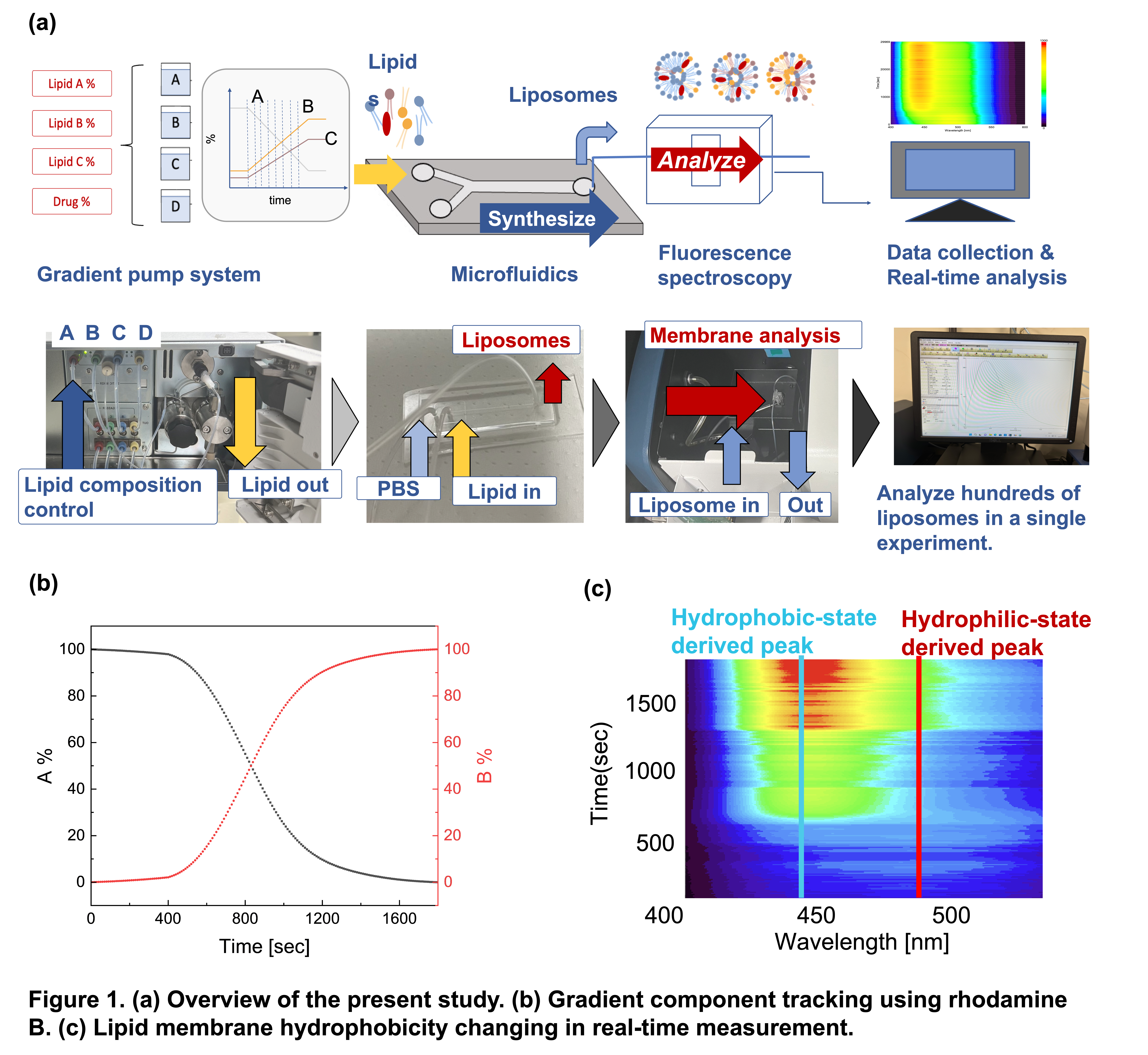
In this study, we developed a continuous composition gradient system integrated with microfluidic liposome synthesis to dynamically modulate lipid composition. Two model lipids, 1,2-distearoyl-sn-glycero-3-phosphocholine (DSPC) and 1,2-dioleoyl-sn-glycero-3-phosphocholine (DOPC), were used to generate binary mixtures via a programmable gradient pump and High-Performance Liquid Chromatography (HPLC) mixer. Rhodamine B was employed as a fluorescent tracer for composition tracking. liposomes were synthesized in-line and directly introduced into a fluorescence spectrometer to in-situ evaluate membrane hydrophobicity.
In the DSPC/DOPC system, membrane hydrophobicity showed a clear, monotonic increase with increasing DSPC content, ranging from –0.2 to 0.5 in relative polarization value. These changes are attributed to the formation of more ordered lipid membranes due to the saturated hydrocarbon tails of DSPC. The use of Rhodamine B enabled precise tracking of lipid composition over time, allowing us to construct composition–hydrophobicity across hundreds of unique lipid formulations. This high-resolution analysis demonstrated that even small variations in lipid composition can lead to substantial changes in membrane properties.
Our results confirm the feasibility of using composition gradients in microfluidic systems for the high-throughput screening of liposome characteristics. The integration of real-time fluorescence monitoring with controlled lipid mixing provides a tool to accelerate formulation optimization for liposomal drug delivery. The insights from this study advance our understanding of how lipid composition governs membrane behavior, and the methodology may serve as a platform for broader applications in lipid membrane characterization.