2025 AIChE Annual Meeting
(533d) Shape-Morphing Active Particles with Invertible Polarizability for Configurable Locomotion and Steering
Authors
Jin Gyun Lee - Presenter, Louisiana State University
Seog-Jin Jeon, Kumoh National Institute of Technology
Ryan Hayward, University of Colorado Boulder
C. Wyatt Shields, University of Colorado, Boulder
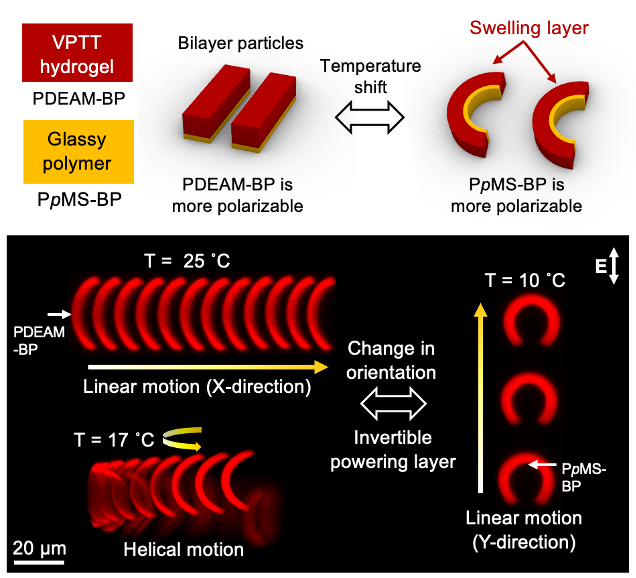
In nature, microorganisms undergo physical contortions through controlled shape transformations to propel in viscous fluids for swimming toward nutrients or evading predators. Active particles are ostensible analogs of these natural swimmers because they can locally dissipate energy to propel in low Reynolds number environments. However, most active particles developed to date lack the ability to undergo directed shape transformations due to limitations in manufacturing and controlling stimuli-responsive materials at the microscale. Here, we present the shape-dependent propulsion of stimuli-responsive microparticles with fully reversible bending. Particles were fabricated from a bilayer comprising a thermoresponsive hydrogel and a non-swelling glassy polymer. The photocurable layers were lithographically patterned into rectangular prisms (40 µm by 4 µm; 2 µm thick). Due to the large change in swelling of the hydrogel induced by temperature changes near their volume phase transition, the particles exhibited large changes in curvature, morphing from nearly flat plates at 35°C to crescent-shaped particles with a radius of curvature of 44 µm at 20°C. The surrounding temperature change also modulates the polarizability of swelling layer while the rigid layer remained unchanged, allowing for dynamic control over which layer is more polarizable. When powered by AC electric fields, thermally dictated alterations to particle geometry and polarizability drove the particles to change their trajectories by shifts in the surrounding unbalanced fluid flows. The programmable temperature-dependent motions of the particles include lateral linear propulsion, longitudinal linear propulsion, and three-dimensional helical propulsion. We demonstrate that accessing these different modes through sequenced temperature changes enables encoded in situ steering of the particles. The principles described in this study provide a foundation to design new microscale active systems that enable propulsion, reconfiguration, and steering at the single-particle-level.