2025 AIChE Annual Meeting
(63j) Self-Organization of Active Extended Proteins on Lipid Membranes
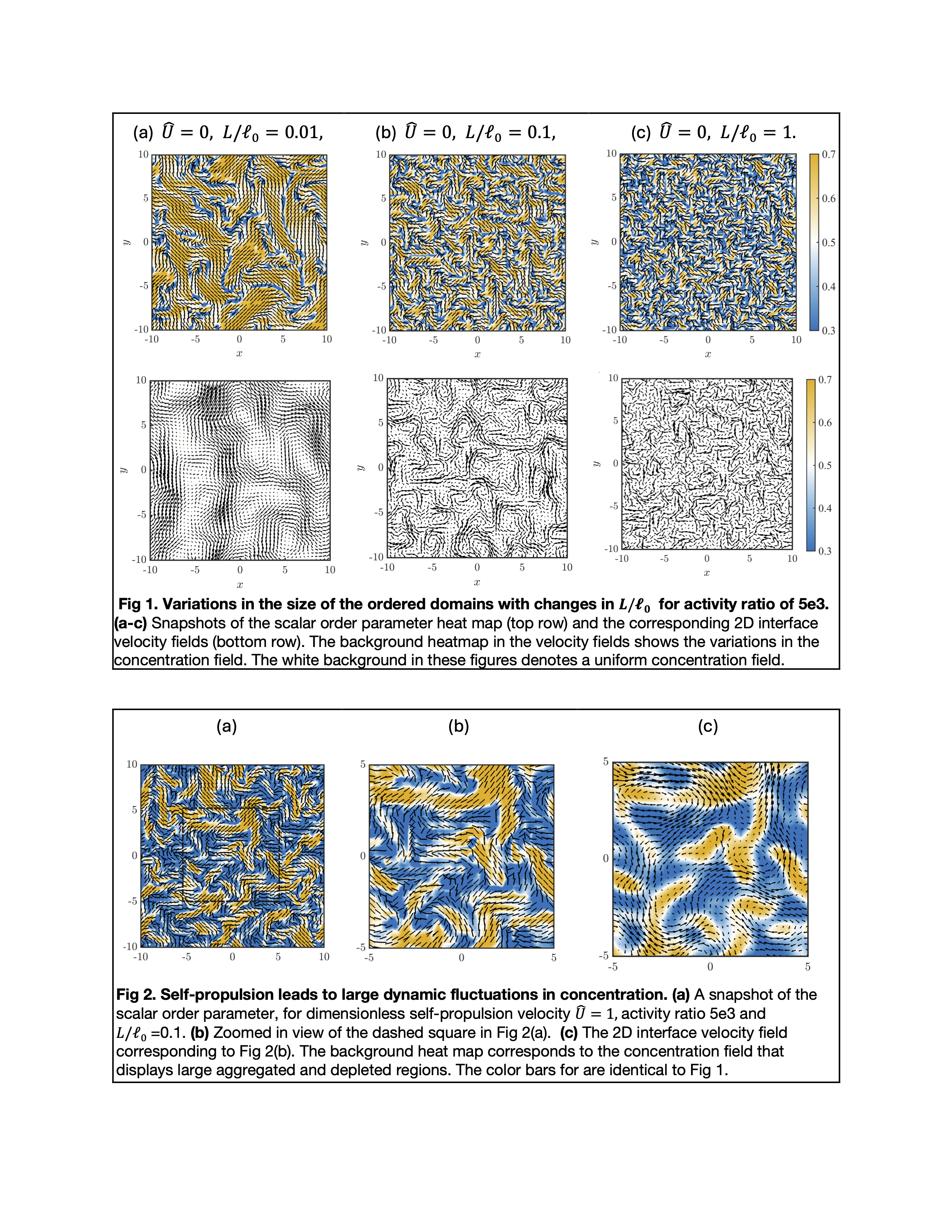
Many biological processes involve the transport and self-organization of inclusions in thin fluid interfaces. Examples include the assembly of proteins on a lipid membrane, dynamic organization of actin filaments in the cell cortex and dynamics of cells in tissues. A key aspect of these assemblies is the active dissipative stresses applied from the inclusions to the fluid interface, resulting in long-range active interfacial flows. We study the effect of these active flows on the self-organization of rod-like inclusions on fluid interfaces. Specifically, we consider of dilute suspensions of colloidal rods of length L, embedded in a thin fluid interface of viscosity ηm and surrounded on both sides with 3D fluid domains of viscosity, ηf. We use zeroth, first and second moments of Smoluchowski equation to obtain the conservation equations for concentration, polar order and nematic order, and use linear stability analysis and continuum simulations to study the dynamic variations of these fields as a function of L/l0, the ratio of active to thermal stress, and the dimensionless self-propulsion velocity of the embedded particles. Here, l0 = ηm / ηf is the ratio of 2D interface viscosity to 3D fluid viscosity, also known as Saffman-Delbrück length, which determines the length scale over which the flow dissipation in the interface becomes comparable to the dissipation in the surrounding 3D fluid flows. We find that at sufficiently large activities, the suspensions with active extensile stress (pusher) with no directed motion undergo a finite wavelength nematic ordering, with the length of the ordered domains decreasing with increasing L/l0. The ordering transition is hindered with further increases in L/l0. In contrast, the suspensions with active contractile stress (puller) remain uniform with variations of activity. Further increases in L/l0 suppresses the ordering transition in the scale of the rods' length. We also study the effect of self-propulsion velocity on the dynamic behavior of the system. We observe that, in addition to nematic ordering, the system undergoes large density fluctuations when the the self-propulsion timescale becomes comparable and smaller than diffusion time of the embedded particles. We also find that changing self-propulsion speed leads to complex changes in the size of the order domains. Our work highlights some of the key effects of hydrodynamic coupling between fluid interfaces and their surrounding environment on the self-organization of active inclusions on fluid biological interfaces.