2025 AIChE Annual Meeting
(721f) Self-Assembly and Inorganic Hybridization of Ultrathin Isoporous Triblock P4VP-b-PS-b-P4VP Membranes for Liquid Filtration
Authors
Semih Cetindag, Rutgers University
Siddhant Iyer, University of Massachusetts Amherst
Xiao Tong, Brookhaven National Laboratory
Esther H. R. Tsai, Brookhaven National Laboratory
Li Ruipeng, Brookhaven National Laboratory
Kim Kisslinger, Brookhaven National Laboratory
Ashley Head, Brookhaven National Laboratory
Sanat Kumar, Columbia University
Gregory Doerk, Brookhaven National Laboratory
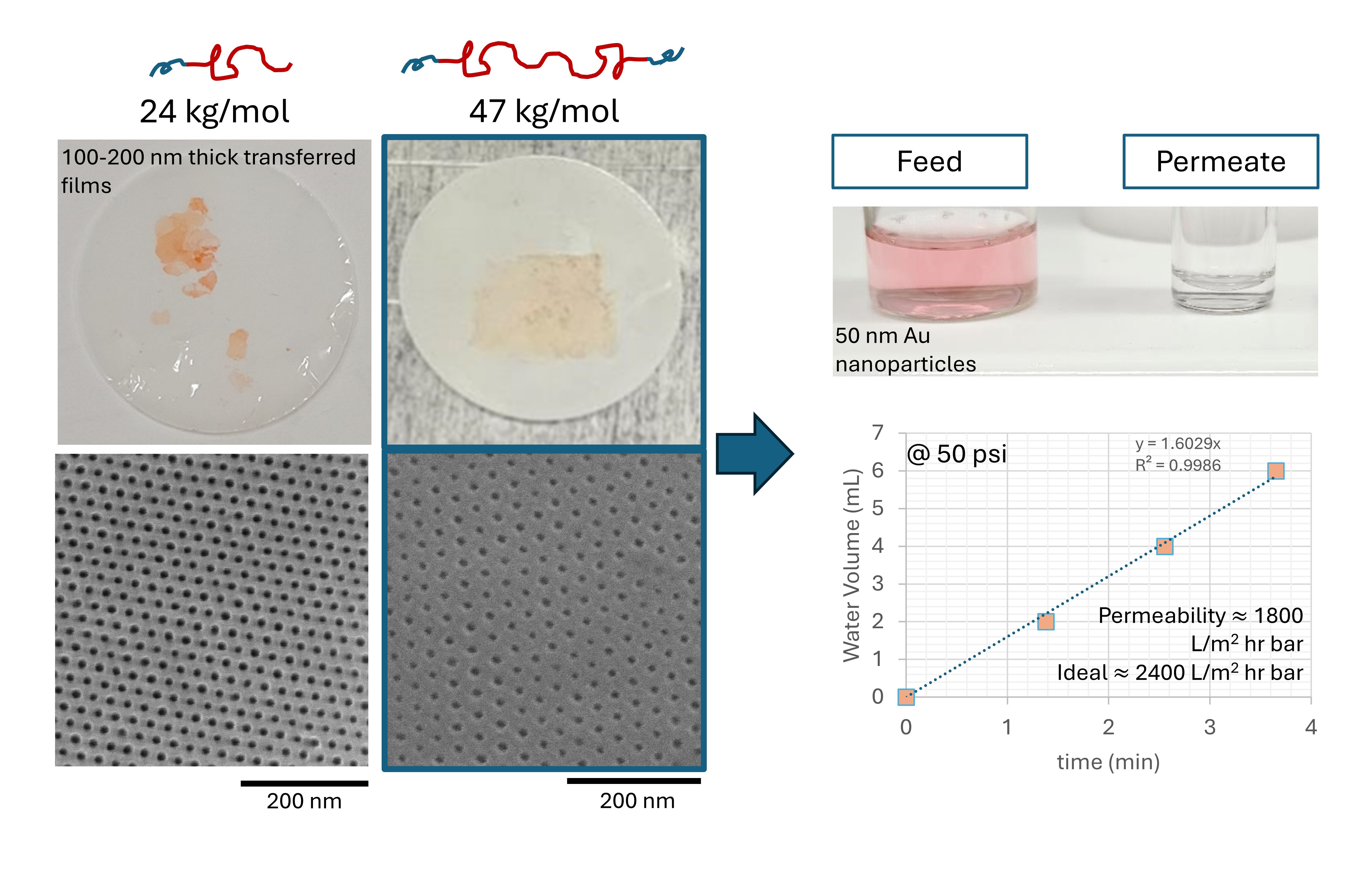
High-performance porous filtration membranes with high permeability and selectivity are increasingly essential for chemical processing, water purification, critical resource recovery, and biomedical separations. Block copolymers present an appealing way to precisely engineer membranes with customizable pore architecture and chemistry by virtue of their self-assembled nanostructure. Here we present the fabrication and characterization of composite membranes with ultrathin (~100 nm) self-assembled poly(4-vinylpyridine)-block-polystyrene-block-poly(4-vinylpyridine) (P4VP-b-PS-b-P4VP) triblock copolymer selective layers that exhibit exceptional water permeability while preserving high selectivity. The composite membrane is made possible by the presence of looping and bridging triblock copolymer chain conformations, which dramatically improve thin film mechanical integrity in comparison to a diblock copolymer analog with the same approximate pore density (> 1015 m-2). Pores with ~10 nm diameters are formed by incorporating P4VP homopolymer, which is selectively extracted from self-assembled cylindrical P4VP domains. The transfer of the triblock copolymer film from silicon substrates onto a track-etched polycarbonate support was facilitated by the substrate-grafted homopolymer underlayer that both ensures vertical cylinder orientation and swells rapidly in dilute acid for complete film delamination. Further tuning of the pore size and chemistry is achieved by infiltrating the P4VP pore walls with metal nitrates via liquid phase infiltration to an extent controlled by the ratio of water and ethanol solvent. These salts are subequently converted to metal oxides through UV exposure that preserves the self-assembled morphology, yielding vertical pores as small as ~5 nm. These resulting hybrid polymer-metal oxide isoporous membranes open new opportunities for foulant mitigation and permit further functionalization for targeted separations and designer stimuli responses.