2025 AIChE Annual Meeting
(700c) Scale-up of Modified Amine-Based Sorbent for Passive Direct Air Capture
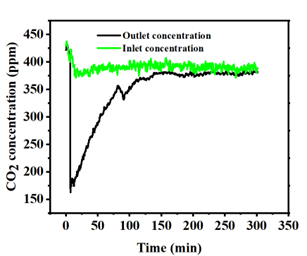
In this study, our modified amine-based sorbent was washcoated onto a scaled monolith block and evaluated to determine its adsorption performances. A passive air contactor (PAC) was designed and installed in an environmental chamber where wind speed, temperature, and humidity were controlled to simulate different climatic conditions. A fan was used to simulate different ambient wind speeds and linear velocities inside the contactor. The PAC could accommodate one or two sorbent-coated monolith block(s) with the dimensions of 15 cm x 15 cm x 15 cm. The adsorption data was collected under various temperature, relative humidity, and simulated wind speed conditions. After each saturation step, the sorbent-coated monolith block was regenerated under a vacuum at a desorption temperature and the desorbed gas was collected and analyzed to determine its purity and recovery.
The adsorption data from the bench-scale tests was compared with those for powdered sorbent and small monolith blocks obtained. Furthermore, the adsorption isotherm and kinetic models coupled with a fluid flow model were applied to the monolithic structure for the prediction of the adsorption performances. Based on the performances, key performance metrics including overall CO2 capture efficiency, volumetric productivity, and pressure drop will be presented.