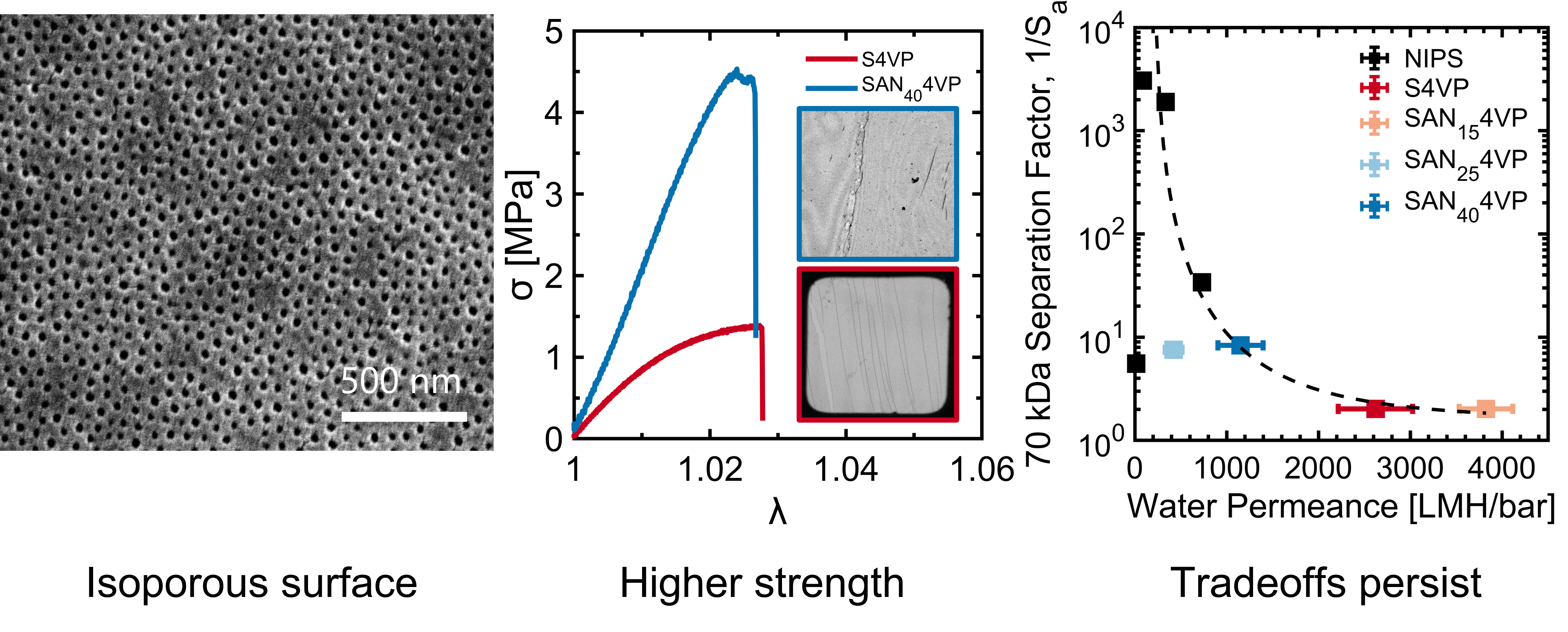
Ultrafiltration (UF) membranes are ubiquitous in water purification and bioprocessing. However, co-designing their mechanical and transport properties remains challenging because their typical manufacturing process, nonsolvent-induced phase separation (NIPS), leads to kinetically arrested structures with broad pore size distributions at the surface and within the bulk. These distributions lead to relatively broad rejection curves and the presence of pores acts as sites for stress concentrations that compromise mechanical properties. Novel materials capable of stabilizing such stress concentrations while providing membranes with narrow rejection curves are critical for the next generation of UF membranes
This study introduces one class of such materials: SAN4VP, a block copolymer composed of a hydrophobic poly(styrene-co-acrylonitrile) block and a hydrophilic poly(4-vinyl pyridine) block. By considering a series of block copolymers of constant molecular weight, Mn ≈ 115 kDa, and varying acrylonitrile content (AN), the poster will show that the incorporation of AN into the styrenic block leads to stronger and tougher UF membranes, likely due to an increase in the entanglement density and a transition in the failure mode from crazing to crazing/shear deformation zones. This improvement in mechanical properties, however, decreases water permeance and alters PEG rejection. Overall, this study introduces a molecular design for manufacturing mechanically robust membranes, while highlighting some of the challenges associated with co-designing the mechanical and transport properties of polymer membranes.