2025 AIChE Annual Meeting
(441f) Safety By Design: Leveraging Data-Rich Experimentation and Process Modeling Towards a Digital Twin
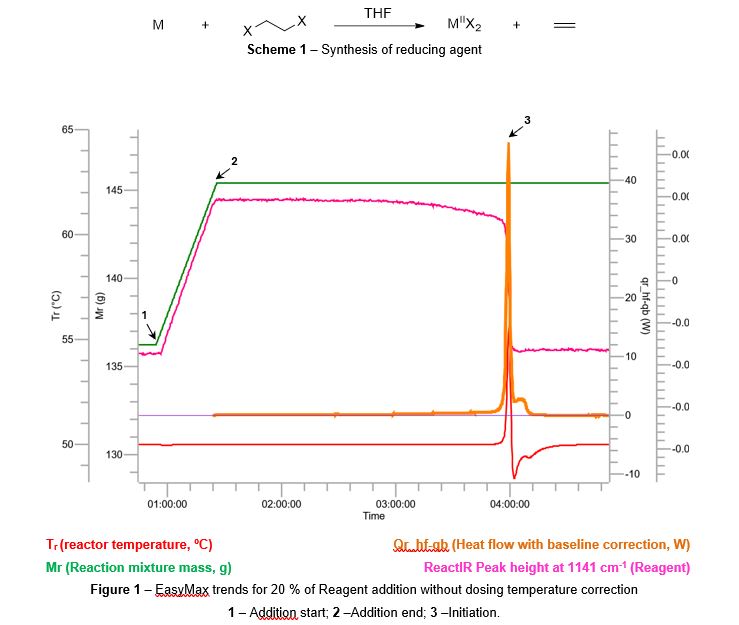
To overcome these challenges, a data-rich experimental framework was implemented, moving beyond traditional intuition-based safety assessments. Reaction calorimetry was employed to characterize the thermal behavior of the process, providing precise measurements of heat evolution and quantifying gas release. Real-time monitoring with FT-IR captured reaction kinetics and reagent consumption rates (Figure 1). The integration of these techniques facilitated a deeper mechanistic understanding, enabling the refinement of process conditions and enhancing operational safety.
Further investigation included assessing the manufacturing reactor's heat transfer characteristics using an exothermic model reaction. This step enabled the creation of a digital twin, which provided critical insights into process performance in the manufacturing reactor, by predicting heat- and mass-transfer effects for plant transfer. The resulting data facilitated the optimization of scale-up parameters ensuring safe operating conditions.
Overall, integrating advanced process modeling with data-rich experimentation proved pivotal in optimizing critical process parameters, accurately predicting scale-up scenarios, and establishing robust safety measures. This data-driven approach not only delivers Right First Time performance but also significantly reduces risks associated with exothermic reactions and flammable gas release, facilitating a seamless and safer transition to production scale.