2025 AIChE Annual Meeting
(390ad) A Robust Campd Framework Based on Transfer-Learning Surrogate Models: Application to Carbon Dioxide Capture
Authors
Addressing the vast chemical and process design space, our prior work introduced a robust computer aided molecular and process design (CAMPD) framework [2]. However, due to the inherent non-linear relationships among solvent structures, thermodynamic properties, and process performance, model simplifications, such as equilibrium-stage models, were necessary. In the current study, we employ machine learning (ML) surrogate models to enhance the accuracy and tractability of our process model. The improved accuracy is primarily achieved by transitioning from an equilibrium-based absorber model to a rate-based absorber model. Utilizing the ML surrogate enables the adoption of the rate-based model without increasing computational costs. This is achieved by substituting computationally intensive flash calculations, previously performed using the rigorous SAFT γ-Mie equation of state and a pT flash algorithm, with a streamlined artificial neural network (ANN) surrogate for the well-characterized monoethanolamine (MEA) system. This approach yields up to an 80% reduction in computational time compared to the rigorous SAFT γ-Mie rate-based model without compromising the quality of the optimization results [3].
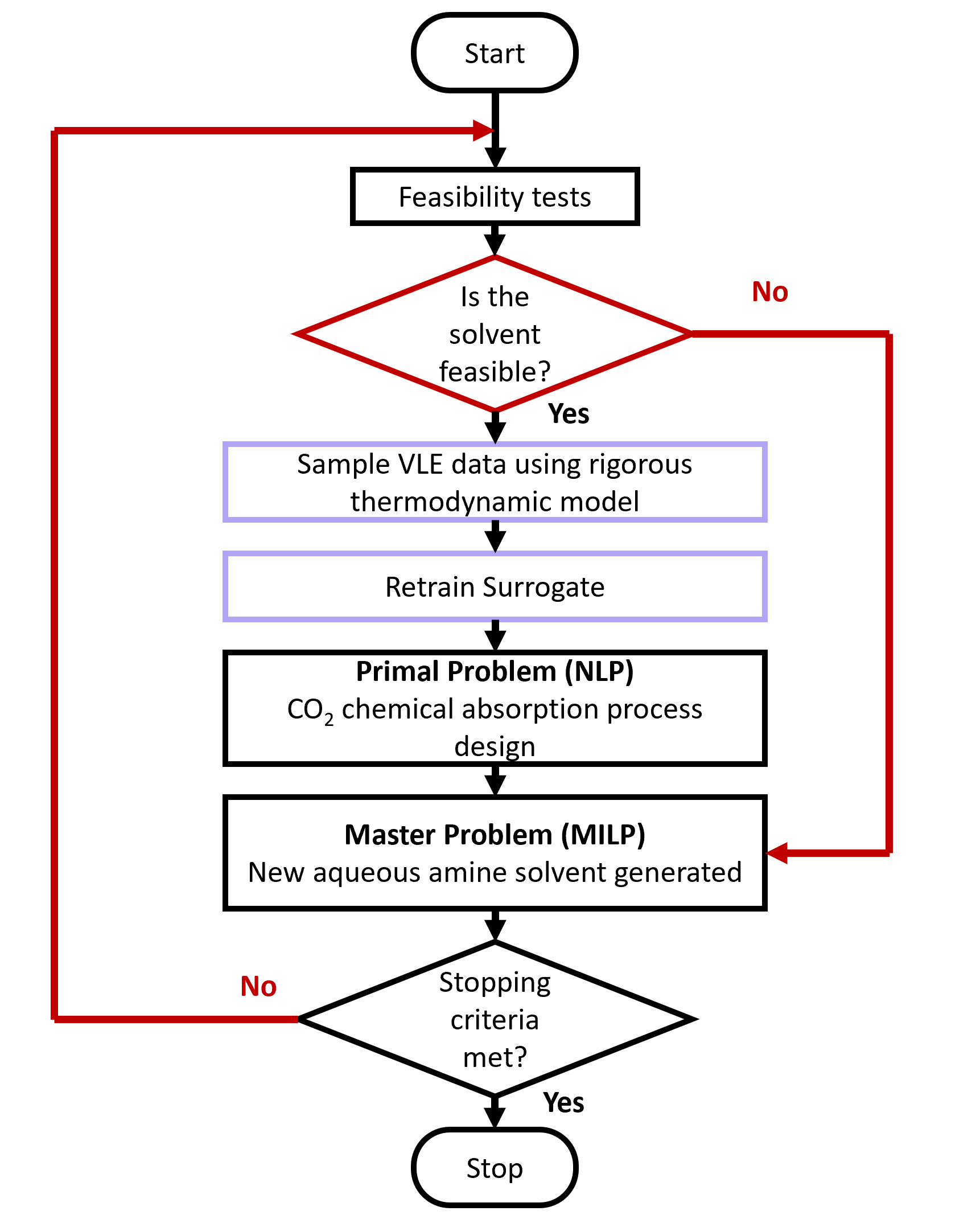
Expanding upon this promising foundation, we leverage transfer learning methods to rapidly adapt the pre-trained MEA surrogate to new solvent systems. Importantly, while this integration into the comprehensive CAMPD framework slightly offsets the computational savings, it facilitates embedding surrogate models into the entire CAMPD workflow, see Figure 1, achieving a net reduction in optimization times of approximately 50% compared to using rigorous thermodynamic calculations in the rate-based model.
In conclusion, our application of transfer learning using a pre-trained machine learning surrogate significantly accelerates integrated molecular and process design optimization. This advancement particularly enables viable global optimization via multi-start approaches across both the chemical and process design spaces. Furthermore, the demonstrated advantages of this approach could be generalized to other complex optimization problems within chemical and process engineering, ultimately paving the way toward more efficient and economically viable technologies.
References
[1] M. Bui, C. S. Adjiman, A. Bardow, E. J. Anthony, A. Boston, S. Brown, P. S. Fennell, S. Fuss, A. Galindo, L. A. Hackett, J. P. Hallett, H. J. Herzog, G. Jackson, J. Kemper, S. Krevor, G. C. Maitland, M. Matuszewski, I. S. Metcalfe, C. Petit, G. Puxty, J. Reimer, D. M. Reiner, E. S. Rubin, S. A. Scott, N. Shah, B. Smit, J. P. M. Trusler, P. Webley, J. Wilcox, N. Mac Dowell, Carbon capture and storage (CCS): the way forward, Energy Environ. Sci., 11, 5 (2018)
[2] L. Lee, A. Galindo, G. Jackson, C. S. Adjiman, Enabling the direct solution of challenging computer-aided molecular and process design problems: Chemical absorption of carbon dioxide, Comput. Chem. Eng., 174 (2023)
[3] F. Baakes, G. Chaparro, T. Bernet, G. Jackson, A. Galindo, C. S. Adjiman, Utilizing ML Surrogates in CAPD: Case Study of an Amine-based Carbon Capture Process, PSE Press (ESCAPE 35), accepted (2025)