2025 AIChE Annual Meeting
(389ai) Revealing the Water Structure at Neutral and Charged Graphene/Water Interfaces through Quantum Simulations of Sum Frequency Generation Spectra.
Authors
Toheeb Balogun - Presenter, Louisiana State University
Golam Azom, Louisiana State University
Revati Kumar, Louisiana State University
Francesco Paesani, UC San Diego
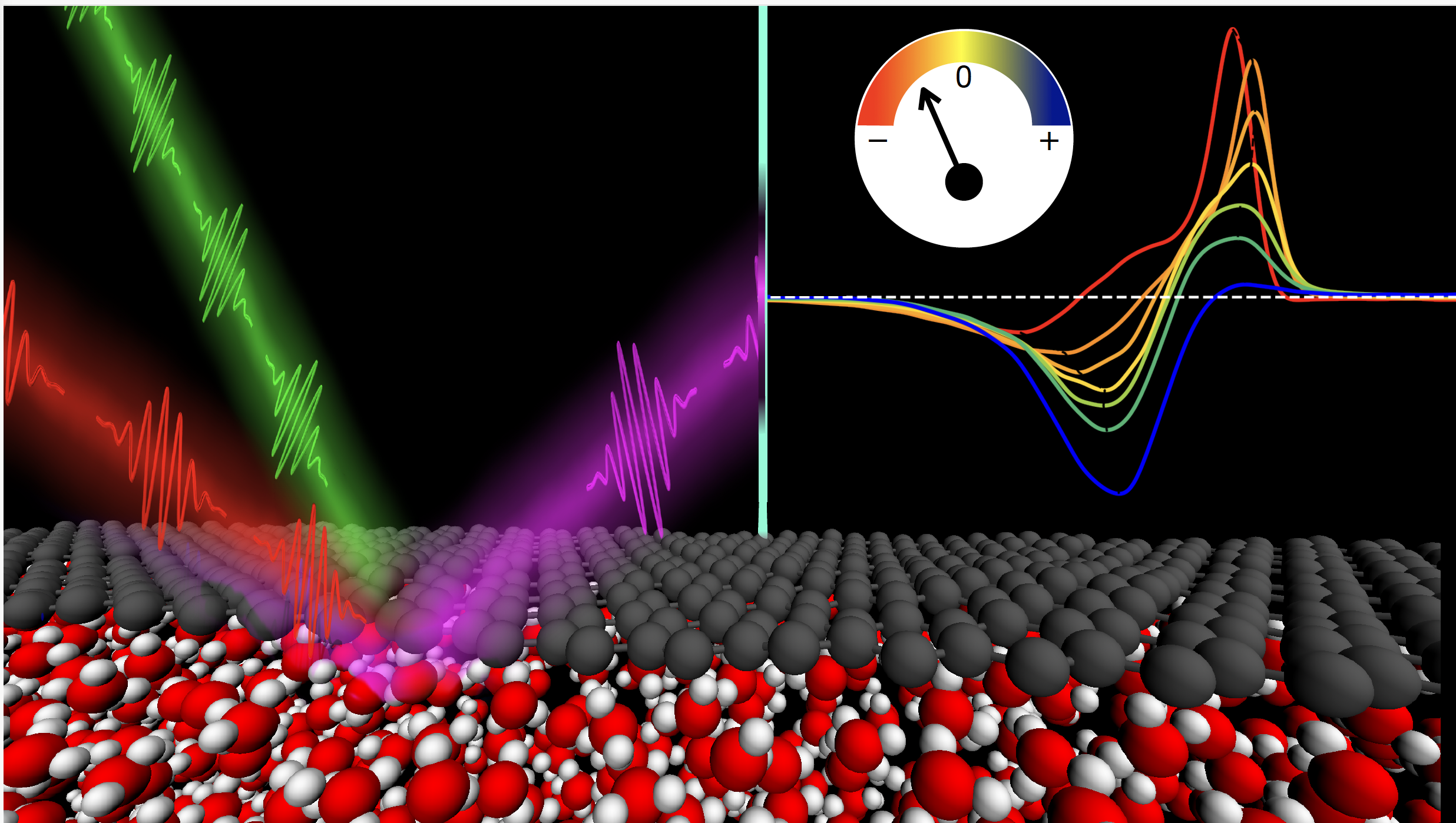
The structure and dynamics of water at charged graphene interfaces fundamentally influence molecular responses to electric fields, with implications for applications in energy storage, catalysis, and surface chemistry. Leveraging the accuracy of the MB-pol data-driven many-body potential combined with advanced path-integral quantum dynamics, we analyze the vibrational sum frequency generation (vSFG) spectra of graphene/water interfaces under varying surface charge conditions. Our quantum simulations reveal a distinctive dangling OH peak in the vSFG spectrum at neutral graphene—consistent with recent experimental findings, yet notably divergent from earlier interpretations. As the graphene surface becomes positively charged, interfacial water molecules reorient, leading to a reduction in the intensity of the dangling OH peak as OH groups turn away from the interface. Conversely, under negative surface charge, water molecules orient their OH bonds toward the graphene sheet, producing a prominent dangling OH feature. This charge-induced molecular reorganization drives the emergence of diverse hydrogen-bonding topologies at the interface, governed by changes in local electrostatics. Crucially, these structural perturbations extend beyond the first interfacial layer, creating an asymmetric distribution of OH bond orientations that enhances bulk-like spectral contributions. These findings underscore the complex, many-body interactions governing the molecular architecture of water at charged graphene interfaces and demonstrate the importance of quantum-level modeling for accurate spectral interpretation.