2025 AIChE Annual Meeting
(186m) Research on Influential Factors to Enhance Nanoparticle Sol-Gel Composites
Authors
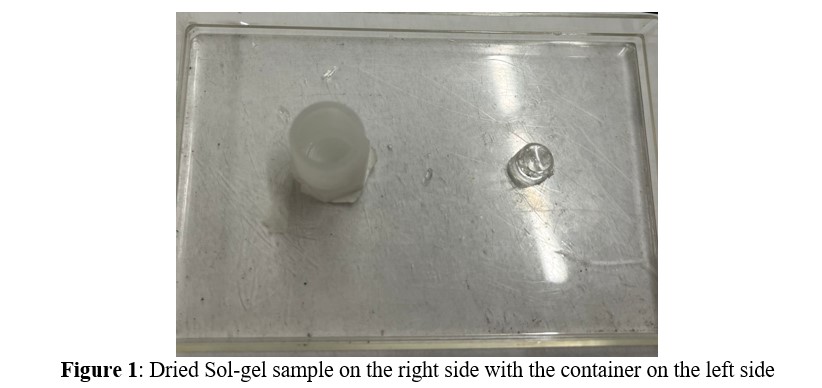
The aim of our experiment was to improve the structural integrity and hardness of the sol-gel product. The impact of the HCl concentration, titanium dioxide concentration, drying time, drying temperature, and mixing time (i.e. reaction time) were investigated through an L16 orthogonal design [2]. The Brinell Hardness (HB) of the sol-gels were measured with a Leeb hardness tester with a lower detection limit (LDL) of 45 HB. The structural integrity was quantitatively inferred through the hardness level and qualitatively analyzed visually. The presence of cracks, non-uniformity and formation of powder would imply undesirable sol-gel formation. The results of the experiment show that the hardness was the highest at the maximum titanium dioxide concentration of 60 microliters added to the solution. The drying conditions were optimal when the sol-gel was in the oven for 2 days at 50℃, where beyond those conditions the sol-gels structural integrity would be compromised by cracking and thermal degradation into powder. The optimal concentration of HCl was 0.001 M with 3.2 mL being added, with caveats that HCl concentrations of 0.1M and 0.01M marginally underperformed when compared to 0.001M HCl and reaction time was short-lived (1-4 minutes) compared to a 4-hour mixing time in another research paper [3]. The optimal mixing time was 3 minutes upon analysis.
Further experiments are required to decode and optimize the conditions for a structurally stable nanoparticle sol-gel composites. To yield a structurally sound sol-gel with higher hardness that may be applicable in industry; Mitigating human error and use of more precise machinery alongside a larger range of experimental conditions will be crucial.
References:
[1] Livage, J, & Sanchez, C. (1992). Sol-gel chemistry. Journal of Non-Crystalline Solids, 11–19. https://doi.org/https://doi.org/10.1016/S0022-3093(05)80422-3.
[2] Xie, X., Deng, Y., Peng, J., Zheng, S., Cao, C., Xie, W., & Li, X. (2020). Nanoparticle‐Reinforced Silica Gels with Enhanced Mechanical Properties and Excellent pH‐Sensing Performance. Particle & Particle Systems Characterization, 37(2), 1900404.
[3] McPolin Daniel O., Basheer P. A. Muhammed, Grattan Kenneth T. V., Long Adrian E., Sun Tong, & Xie Weiguo. (2011). Preliminary Development and Evaluation of Fiber-Optic Chemical Sensors. Journal of Materials in Civil Engineering, 23(8), 1200–1210. DOI:10.1061/(ASCE)MT.1943-5533.0000290