2025 AIChE Annual Meeting
(675b) Redefining Catalysis Predictions through Physics-Based Gaussian Model and Data-Driven Benchmarks: Au-Pd Alloy in ORR for Fuel Cell Applications
Authors
Ng Yan Ting, Agency for Science, Technology and Research
Kedar Hippalgaonkar, Nanyang Technological University
Tej Choksi, Nanyang Technological University
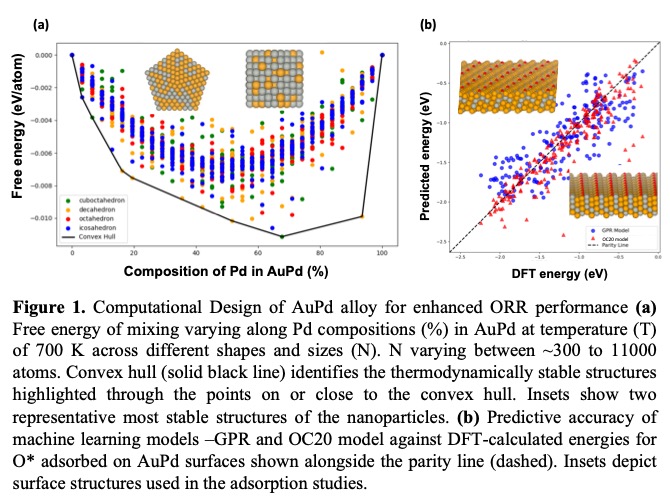
The global push for sustainable energy and climate change mitigation drives the pursuit of transformative innovations in renewable energy technologies. Fuel cells are particularly promising, and alloying Pd with Au can tune electronic structures for improved oxygen reduction reaction (ORR) performance and H₂O selectivity. In this study, we present an end-to-end machine learning-guided computational framework that uniquely integrates density functional theory (DFT) with a physics-based Gaussian Process Regression (GPR) model, amalgamating stability and reactivity predictions through an alliance of our bespoke model and foundational models from the OpenCatalyst (OC) Project by FAIRCHEM, Meta. We began with the identification of stable nanoparticle (NP) compositions and morphologies derived from cohesive energy calculations within the bond-cutting model framework. By analyzing over 1100 datasets across a spectrum of NP sizes (309 to 11000 atoms), shapes (cuboctahedron, decahedron, octahedron, and icosahedron), and varying configurations, cuboctahedron and decahedron shapes with smaller atom counts (N < 1100) and 60-80 % Pd compositions exhibit enhanced stability at 700 K. To assess catalyst reactivity, we employed GPR models trained on small, high-quality DFT datasets, across diverse AuPd surface facets and compositions. Our model achieved a strong predictive accuracy for ORR intermediates adsorption energies, with a mean absolute error (MAE) of 0.22 eV, by harnessing only three critical fingerprints—cohesive energy, electronegativity, and bond distance. Foundational models from OC (SCN, SchNet, GemNet, DimeNet++, and EquiFormerV2) showed an MAE of 0.29 eV, suggesting bespoke models offer precision, while foundational models provide adaptability and insight into new chemical spaces. The integration of OC models enables high-throughput screening of ORR active sites, guiding targeted DFT calculations to generate compact and high-quality training data for bespoke GPR models. This hybrid approach lays the foundation for correlating catalytic activity, selectivity, and reactivity with DFT and literature data, supporting catalyst optimization under operational conditions.