2025 AIChE Annual Meeting

(525c) Redefining Ammonia Synthesis Reactors – Optimal Reactor Design Considering Options for Electrical Energy Integration

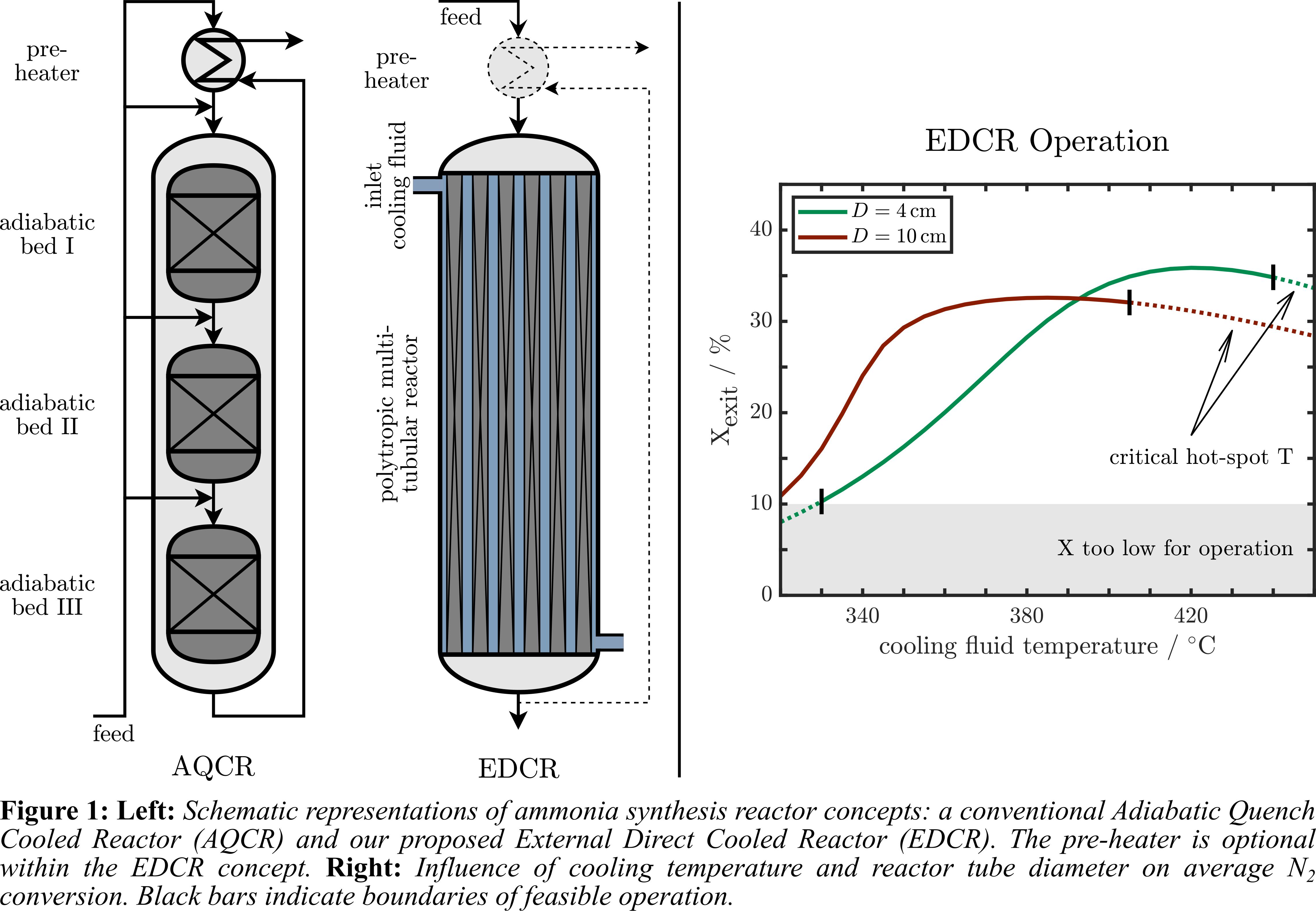
Conventional autothermal ammonia reactors (Figure 1, left: AQCR) are strongly constrained by thermodynamic, kinetic, and stability limitations, making them unsuited for highly dynamic load-flexible operation in Power-to-Ammonia applications. The use of polytropic fixed-bed reactors for ammonia synthesis (Figure 1, left: EDCR) represents a promising solution, as they outperform conventional reactor concepts in terms of single-pass conversion (+ 50 %) and dynamic flexibility, while still leaving ample scope for design optimization. The enhanced dynamic flexibility can be attributed largely to the external heat supply via the cooling jacket, as it markedly reduces the impact of the thermal inertia of the heavy catalyst packing. Adding electrical heaters to the reactor configuration offers an additional option for heat supply – a topic that is already intensively discussed for start-up procedures and heating of endothermic reactions. In case of ammonia synthesis, combining heat transfer via the cooling jacket with additional quick response electric heating options could extend the steady-state operating range and further enhance load-flexibility.

Building up on these considerations, this study focusses on determining an optimal EDCR design for load-flexible operation by detailed numerical optimization studies, including options for electrical energy integration. The EDCR is described with a two-dimensional dynamic pseudo-homogeneous reactor model. A highly active industrial iron catalyst is considered in our calculations.

Our initial EDCR design requires cooling temperatures above 380 °C for achieving high conversion rates (Figure 1, right: D = 4 cm), which is not feasible when using thermal oil as the heat transfer fluid. However, the cooling temperature can be reduced by increasing the reactor tube diameter from 4 to 10 cm (Figure 1, right: D = 10 cm). By supplying additional electric energy, cooling temperatures are further decreased and faster start-up and turn-down times are achieved. For comparison, we will also present an optimized AQCR design.