2025 AIChE Annual Meeting
(382ah) Rapid Crystallization of Zeolites with Controllable Defects: Disentangling Fluoride Concentration and pH Using NH f
Authors
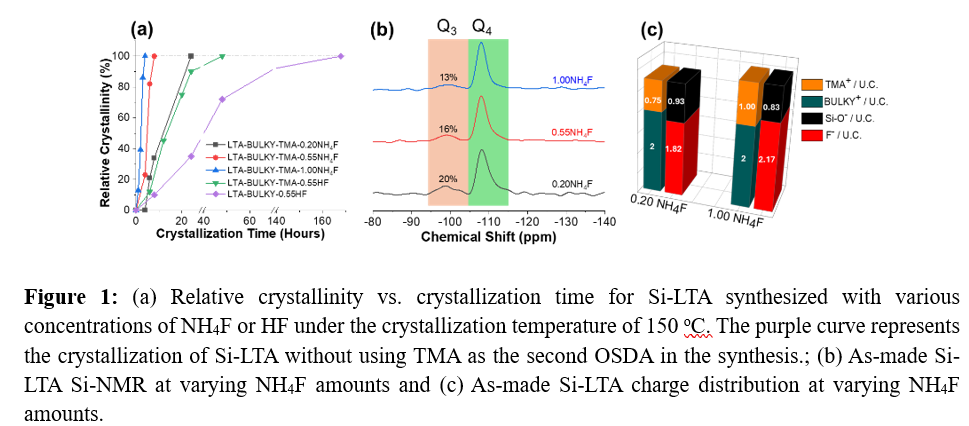
Zeolites are ideal for a wide range of industrial applications due to their large surface area, accessible active sites, tunable surface properties, and excellent hydrothermal stability. However, their synthesis still presents significant challenges, including prolonged crystallization times and the use of hazardous chemicals. Zeolite synthesis is typically done in either basic or neutral fluoride media. Basic conditions speed up crystallization but cause more defects, while neutral fluoride media (using HF) yield crystals with fewer defects but require longer times and involve hazardous HF handling. In the present study, we pursue the best of both synthesis conditions – rapid syntheses with controllable defect concentrations – by disentangling of mineralizing agent and charge-balancing agent using ammonium fluoride (NH4F) as an alternative to HF. We have investigated the use of NH4F in the syntheses of siliceous and aluminum-containing zeolite A, ZSM-5, and siliceous Beta. The crystallization times of all zeolites decreased substantially with increasing NH4F concentration. Crystallization times were reduced from 24 hours to 4 hours (Si-LTA), 96 hours to 36 hours (Al-LTA), 240 hours to 6 hours (ZSM-5), and 24 hours to 3 hours (Si-*BEA). Additionally, increasing NH4F concentration decreases the defect densities of siliceous zeolites. Raman spectroscopy, along with 29Si, 19F,13C MAS NMR, and fluorine elemental analysis of Si-LTA samples confirms that the reduction in charged defects (Si-O-) resulting from higher F- incorporation within the double four-membered rings (D4Rs). These findings demonstrate that the accelerated crystallization is driven by F⁻ enhancing silica mineralization and stabilizing D4R structures. Combining basic and fluoride-media synthesis could therefore be advantageous for faster zeolite production and improved control over structural properties for a wide variety of zeolite structures.
Reference: Shah et. al., Crystal Growth & Design 2025, 25, 6, 1821–1832