2025 AIChE Annual Meeting
(718e) Pyrolyzed Biofilm-Derived Carbon Nanomaterials: A Platform for Sustainable Catalysis
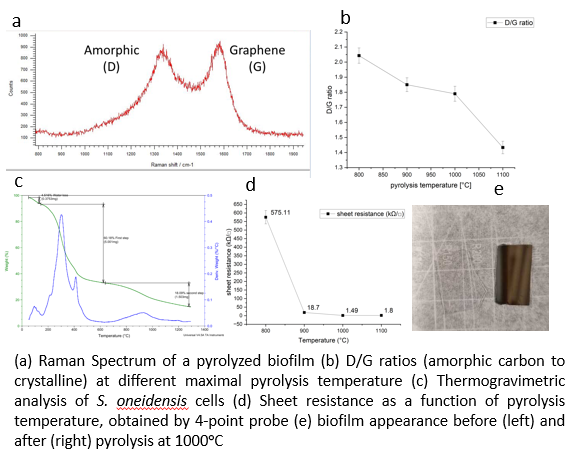
Pyrolysis, a high-temperature thermal decomposition process in the absence of oxygen, has been widely applied to transform organic matter into functional carbon materials. In this work, S. oneidensis biofilms were immobilized on fused silica substrates. The biofilms were pyrolyzed under vacuum (200 mTorr) at heating rates of 5°C/min to temperatures ranging from 700°C to 1100°C. Cross-sectional SEM imaging revealed uniform film thicknesses between 200 and 700 nm, while four-point probe measurements demonstrated sheet resistances of 304–306 Ω/□, comparable to graphite films. Similarly to photoresist-based film pyrolysis, the results also show that as the maximal pyrolysis temperature increases, the sheet resistance decreases drastically from hundreds of kΩ/□ to hundreds of Ω/□. Raman Spectroscopy analysis reveals carbon peaks (D-band at 1300 cm⁻¹ and G-band at 1600 cm⁻¹), where the ratio between the D-band and the G-band areas is a measure of the surface amorphic structure versus crystallinity, which decreases with the increased pyrolysis temperatures. Thermogravimetric analysis revealed a phase change at ~950°C, also pointing at a more crystalline structure at the higher temperature range.
Electrochemical characterization showed that higher pyrolysis temperatures enhanced conductivity and catalytic activity, yielding carbon films with glassy carbon-like properties suitable for electrochemical CO₂ reduction (ECR). The natural capabilities of S. oneidensis in metal ion reduction and nanoparticle biosynthesis further enable the incorporation of catalytic nanoparticles into the biofilm-derived electrodes, providing a multifunctional platform for advanced energy technologies. Preliminary ECR tests suggest that these electrodes suppress hydrogen evolution while favoring selective CO₂ conversion to value-added products.
This approach highlights the versatility of biomass-derived nanomaterials for sustainable applications. The hybrid carbon structure offers high surface area and tunable properties ideal for energy storage devices such as supercapacitors and batteries, in addition to catalytic systems for CO₂ utilization. By converting biowaste into functional carbon nanomaterials, this method reduces reliance on fossil-derived carbons while aligning with circular economy principles. Future work will focus on integrating biosynthesized nanoparticles into these electrodes to further enhance their catalytic performance and exploring broader applications in energy systems and environmental remediation technologies.
References:
(1) Kim, J.; Song, X.; Kinoshita, K.; Madou, M.; White, R. Electrochemical Studies of Carbon Films from Pyrolyzed Photoresist. J. Electrochem. Soc. 1998, 145 (7), 2314–2319.
(2) Mohan, D.; Pittman, C. U.; Steele, P. H. Pyrolysis of Wood/Biomass for Bio-Oil: A Critical Review. Energy Fuels 2006, 20 (3), 848–889.
(3) Wang, G.; Dai, Y.; Yang, H.; Xiong, Q.; Wang, K.; Zhou, J.; Li, Y.; Wang, S. A Review of Recent Advances in Biomass Pyrolysis. Energy Fuels 2020, 34 (12), 15557–15578.