2025 AIChE Annual Meeting
(670d) Probing the Scalability of Secondary Nucleation Induced By Fluid Shear
Authors
Nucleation can be categorized as primary or secondary. Primary nucleation occurs spontaneously, either within the bulk solution (homogeneous) or at foreign surfaces such as stirrers and vessel walls (heterogeneous), while secondary nucleation relies on the presence of crystalline particles in solution. Therefore, primary nucleation kinetics can be extracted from unseeded experiments, while secondary nucleation kinetics require seeded crystallizations. However, seeding parameters such as mass loading ratio or seed size distribution can influence the dominant secondary nucleation mechanism, leading to variations in the kinetic behaviour of the system. Seeding can either induce the growth of parent crystals or promote the formation of new crystals through secondary nucleation, by mechanical impact, leading to attrition or breakage, or via solute clusters in the boundary layer of growing crystals, displaced by the effect of contact or fluid shear [2].
Despite secondary nucleation playing a significant role in many industrial crystallization processes, the dependence of secondary nucleation on fluid shear remains poorly understood, particularly across different scales, as hydrodynamic conditions change enormously from laboratory to pilot plant scales. To better understand the effect of fluid shear on secondary nucleation, experimental methods that isolate fluid shear effects from mechanical impact are necessary. This study, therefore, investigates the influence of fluid shear on secondary nucleation kinetics across multiple scales while eliminating mechanical impact, providing insights into the relationship between hydrodynamics and secondary nucleation mechanisms in seeded crystallization processes.
To isolate the effect of fluid flow, seed-on-a-stick experiments [3] were conducted in 6 mL, 100 mL, and 700 mL vessels, where a single glycine crystal was fixed at a defined position within an agitated supersaturated solution. Unseeded and control experiments without the seed were also performed at each volume. Delay times from seeded crystallizations and induction times from unseeded and control experiments were quantified using either transmissivity or turbidity measurements, depending on scale. Alternatively, nucleation rates were determined via in-situ imaging, with image analysis algorithms [4] tracking the temporal evolution of crystal number density in each vessel.
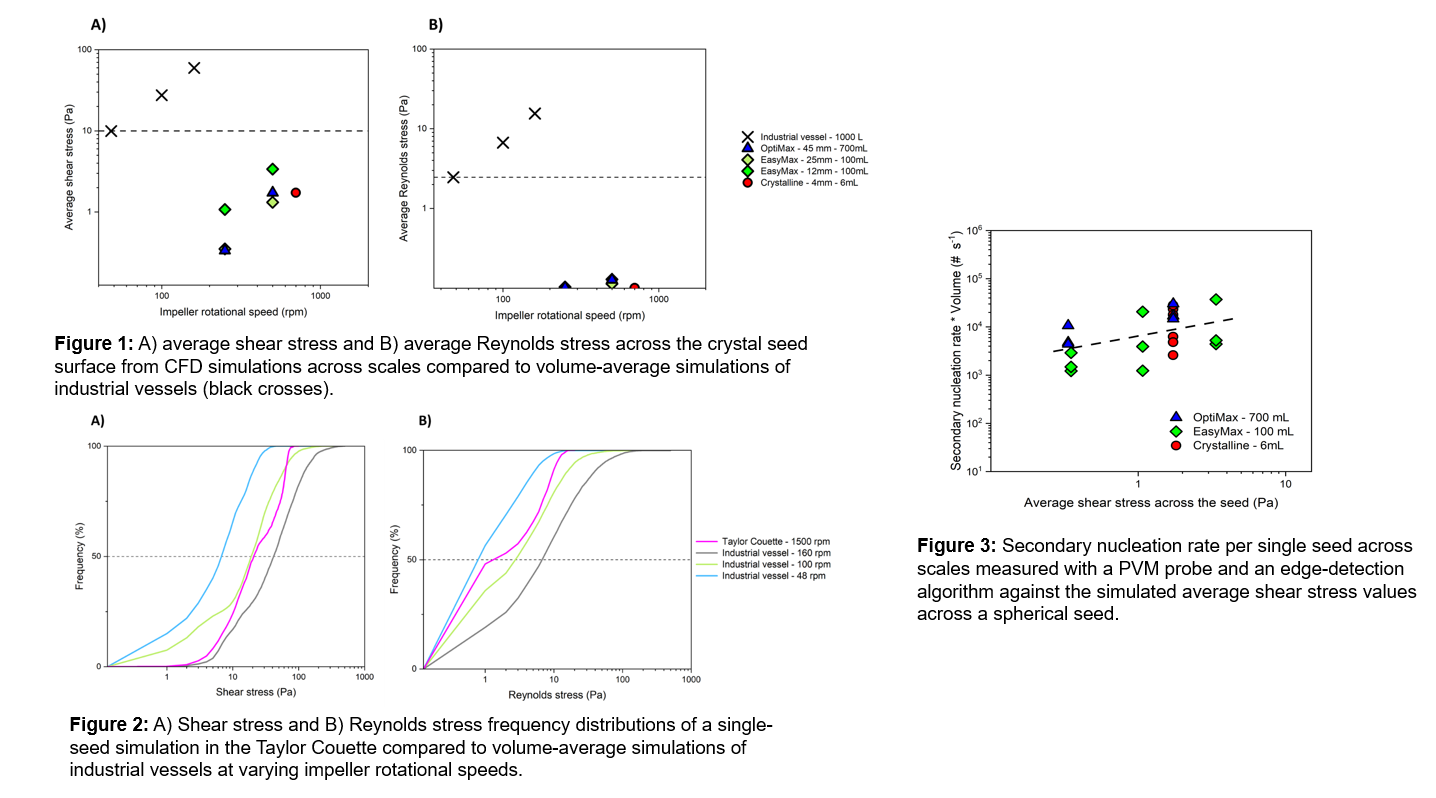
The stresses acting on the fixed seed crystal due to fluid shear were quantified using computational fluid dynamics (CFD), which accounted for both viscous shear and Reynolds stress contributions due to turbulent flow conditions. Comparisons between fixed single-seed simulations of bench-scale vessels and volume-averaged simulations of industrial-scale crystallizers revealed that when the seed location is optimized, values of average shear stress on the crystal seed surface can approach close to those present in industrial vessels. However, levels of Reynolds stress present in industrial vessels are far higher than those in laboratory scale agitated vessels as shown in Figure 1. Interestingly, Taylor-Couette devices, which consist of two concentric cylinders with the inner cylinder rotating, have much higher Reynolds stresses (Figure 2) and thus could be used to evaluate potential effects of turbulent Reynolds stresses on secondary nucleation.
Despite this limitation, single-seed crystallization experiments were conducted under well-characterized flow conditions in agitated vessels to investigate the relationship between shear stress in the vicinity of the seed and secondary nucleation kinetics in multiple vessels across scales. At the smallest scale (6mL), secondary nucleation kinetics were assessed in the Crystalline crystallization platform under two agitation types: magnetic stirring and overhead stirring. Higher nucleation rates and shorter delay times were observed with an overhead stirrer, which was attributed to the shorter distance of the seed to the tip of the impeller and the resulting increase in local shear stress, as confirmed by CFD simulations.
To examine whether this trend persists at larger volumes, single-seed crystallizations were also conducted in the EasyMax (100 mL) and OptiMax (700 mL) vessels, under varying seed positions and agitation speeds, exposing the seed to different fluid shear environments at larger scales. However, at higher volumes, induction times from unseeded experiments overlapped with delay times from seeded crystallizations, indicating that primary nucleation became more prominent when scaling up and complicating the separation of primary and secondary nucleation effects.
Across all scales, the simulated average shear stress across the seed was correlated with experimentally measured secondary nucleation rates, revealing a potential linear relationship regardless of operating volume below 10 Pa, as shown in Figure 3. This trend was observed when using a PVM probe coupled with an edge-detection algorithm for EasyMax and OptiMax vessels.
Overall, these findings contribute to a deeper understanding of how fluid shear influences secondary nucleation kinetics across scales, in isolation from mechanical effects such as crystal breakage or attrition. Our results demonstrate that even in bench-scale systems, where industrial levels of turbulence cannot be fully replicated, secondary nucleation can still be induced solely by the effect of fluid flow. This highlights that well-characterized hydrodynamic environments can provide meaningful insights into shear-induced nucleation behavior. By systematically positioning a single seed crystal within agitated vessels of increasing volume, and correlating CFD-derived estimates of local shear stress with secondary nucleation rates obtained via in-situ imaging, we identified a potential linear relationship between shear stress and secondary nucleation rate that appears to be independent of scale. However, CFD results also revealed that to evaluate whether this relationship holds under industrial turbulence intensities, conventional agitated vessels are insufficient. Therefore, future work will focus on extending this methodology to specialized equipment, such as a Taylor-Couette device, capable of reproducing industrial levels of shear and Reynolds stress in a controlled laboratory setting.
References
1) Devos, C., van Gerven, T. and Kuhn, S. (2021). A Review of Experimental Methods for Nucleation Rate Determination in Large-Volume Batch and Microfluidic Crystallization. Crystal Growth and Design, 21(4), pp. 2541–2565.
2) Yousuf, M. and Frawley, P.J. (2019). Secondary Nucleation from Nuclei Breeding and Its Quantitative Link with Fluid Shear Stress in Mixing: A Potential Approach for Precise Scale-up in Industrial Crystallization. Organic Process Research and Development, 23(5), pp. 926–934.
3) Cashmore, A., Georgoulas, K., Boyle, C., Lee, M., Haw, M. D., & Sefcik, J. (2024). Secondary Nucleation of α-Glycine Induced by Fluid Shear Investigated Using a Couette Flow Cell. Crystal Growth and Design, 24(12), 4975–4984.
4) Cardona, J. et al. (2018). Image analysis framework with focus evaluation for in situ characterisation of particle size and shape attributes. Chemical Engineering Science, 191, pp. 208–231.