2025 AIChE Annual Meeting
(91a) Probing Inclined Plane Flow of Highly Deformable Particles Using a Novel Calibration-Less Bonded-Sphere Model
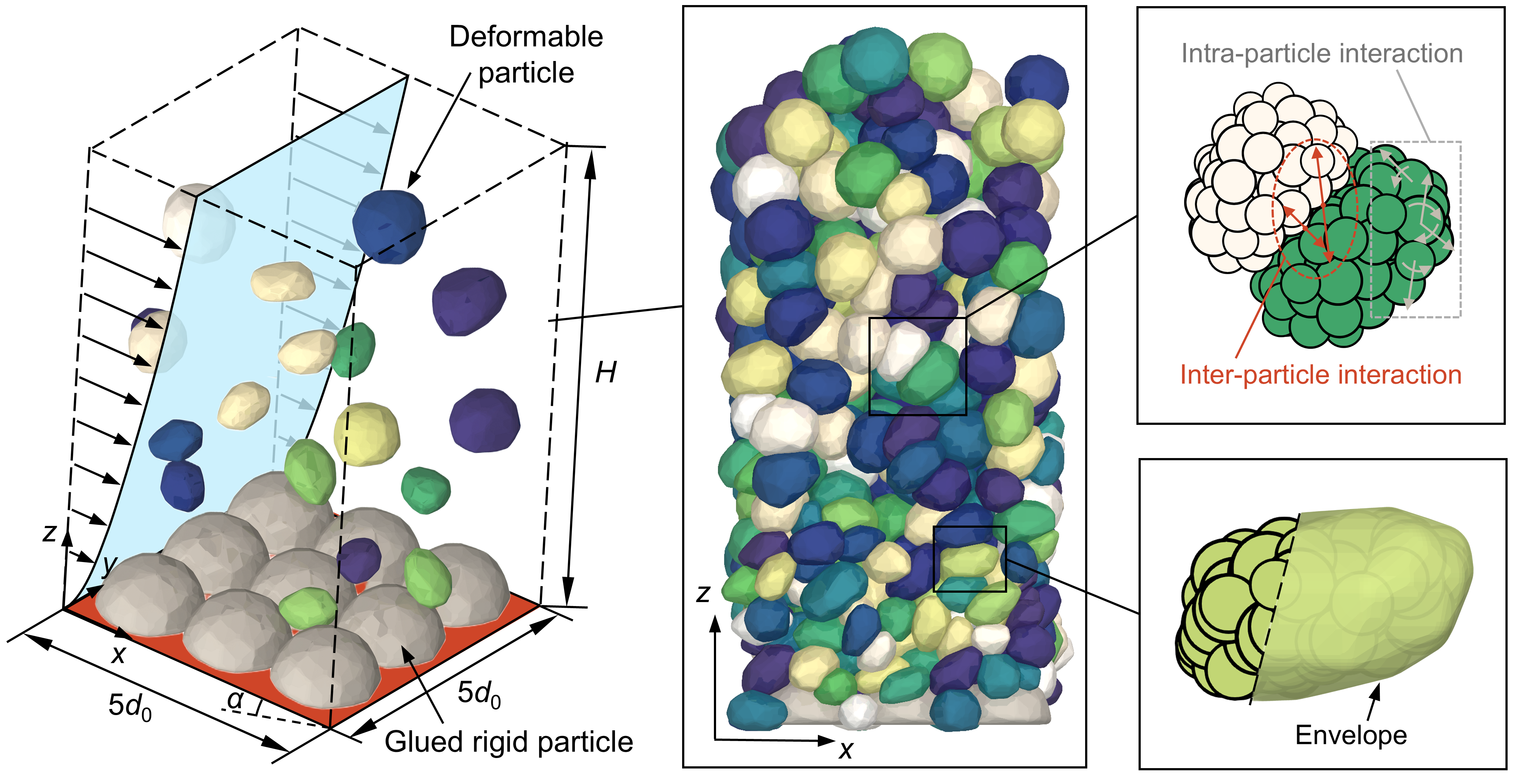
To this end, a bonded-sphere model based on the discrete element method (DEM) is developed that allows for the simulation of highly deformable, linear-elastic particles. Voronoi-tessellation is employed to segment an arbitrarily shaped particle into a network of sub-spheres connected via virtual bonds. This network accurately mimics the mechanical properties of the deformable particle independent of the number (within certain limits) and arrangement of the sub-spheres, making the model calibration-less. Inter-particle collisions are resolved by considering contacts between the respective, contacting sub-spheres. The proposed model is carefully validated using well-established single- and multi-particle benchmark scenarios.
Subsequently, the model is applied to investigate the effect of inclination angle (α) and Young’s modulus (E) on the rheology of inclined plane flows. The parameter p/E is introduced to describe particle deformation, where p is the local granular pressure. For p/E < ~0.1, a mild particle deformation occurs increasing the flowability of the particles as seen by an increased inertial number near the bottom. However, for p/E > ~0.1, the inertial number decreases and the particles exhibit high coordination numbers, indicating a jamming of the flow. Additionally, we observe deformed particles to orient at a certain angle with regard to the main flow; this behaviour is similar to the orientational ordering found for rigid, non-spherical particles5. The orientation angle is a function of p/E, but independent of the inertial number and α.
References
- L.E. Silbert, D. Ertaş, G.S. Grest, T.C. Halsey, D. Levine, and S.J. Plimpton, Phys. Rev. E, 5, 64 (2001).
- V. Kumaran, J. Fluid Mech., 599 (2008).
- H.P. Kuo, Y.C. Hsiao, and P.Y. Shih, Powder Technol., 3, 166 (2006).
- M.L. Manning, Phys. Rev. Lett., 13, 130 (2023).
- T. Börzsönyi, B. Szabó, G. Törös, S. Wegner, J. Török, E. Somfai, T. Bien, and R. Stannarius, Phys. Rev. Lett., 22, 108 (2012).