2025 AIChE Annual Meeting
(661c) Predicting Properties of Two-Dimensional Mxenes Using Machine Learning and Density Functional Theory
Authors
Using density functional theory, we modeled over 2000 MXenes. These include MXenes with n = 1 to 3; M = Ti, Zr, Hf, V, Nb, Ta, Cr, Mo, W; X = C; T = O, S, Se, Te, F, Cl, Br, I, OH, NH; as well as all their potential atomic configurations. We made no assumptions about the most stable configuration of the MXenes, but identified the preferred structure based on thermodynamics. Using the most stable configurations, we calculated various structural, electronic, and mechanical properties of the MXenes. We then used data science and machine learning methods to analyze and develop models on this data. Our goals were: (1) predict a variety of structural, electronic, and mechanical properties, such as lattice constant, work function, or Young’s modulus using machine learning; (2) determine any connections between the constituent elements and the MXene’s properties. This latter goal aims to answer the question: can knowledge of the individual atoms in a MXene be used to predict their properties?
For the ML model development, we used the scikit-learn Python library[1]. Properties of the elements used as features were obtained from XenonPy[2]. We focused on several steps: feature selection and elimination, ML model development and validation, and feature analysis. Our initial pool of potential features was 580, which was excessively large. We first used chemical knowledge to eliminate redundant features (i.e., remove covalent radius but keep atomic radius). Then, we removed highly correlated features. We also applied Recursive Feature Elimination (RFE) to iteratively remove the least important feature from a model and reduce model complexity. Furthermore, we standardized the input predictors and performed 10-repeated 6-fold cross-validation to avoid overfitting.
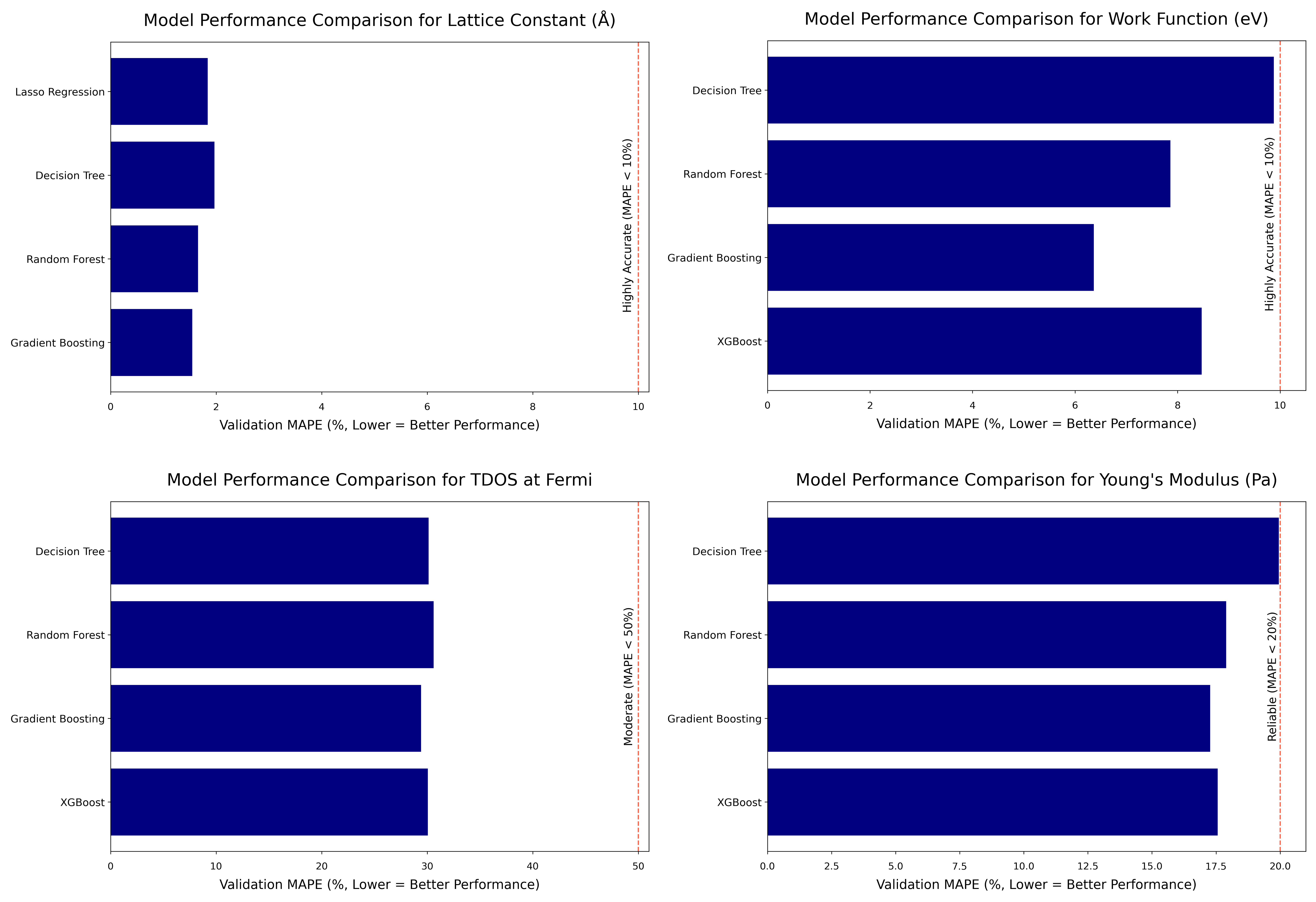
We focused on how well different ML methods predict target properties, and considered Lasso regression, decision trees, random forests, and boosting algorithms. We further analyzed feature importance to identify which features are critical for predicting the target properties. For instance, our results show that Lasso regression proved most effective for lattice constant prediction. On the other hand, gradient boosting methods gave the most accurate predictions on electronic and mechanical properties. Feature analysis indicated that features related to atomic size were important for predicting lattice constants. Important features for predicting other properties included both electronic, thermal, and structural properties of the elements.
Our work shows how pre-processing data, as well as careful feature selection, can enable prediction of material properties using information about the material’s constituent elements. Our work also paves the way to predict which MXenes have desired properties, and why they have such properties based on feature importance. This work informs experimentalists on which MXene compositions may be useful for targeted applications and speeds up materials discovery and development.
[1] Pedregosa, F., Varoquaux, G., Gramfort, A., Michel, V., Thirion, B., Grisel, O., Blondel, M., Prettenhofer, P., Weiss, R., Dubourg, V., Vanderplas, J., Passos, A., Cournapeau, D., Brucher, M., Perrot, M., & Duchesnay, É. (2012). Scikit-learn: Machine Learning in Python. Journal of Machine Learning Research, 12, 2825–2830. https://doi.org/10.1007/s13398-014-0173-7.2
[2] Yamada, H., Liu, C., Wu, S., Koyama, Y., Ju, S., Shiomi, J., Morikawa, J., & Yoshida, R. (2019). Predicting Materials Properties with Little Data Using Shotgun Transfer Learning. ACS Central Science, 5(10), 1717–1730. https://doi.org/10.1021/acscentsci.9b00804