2025 AIChE Annual Meeting
(185h) Precise Control of Semiconducting Polymer Film Thickness for Device Applications
Authors
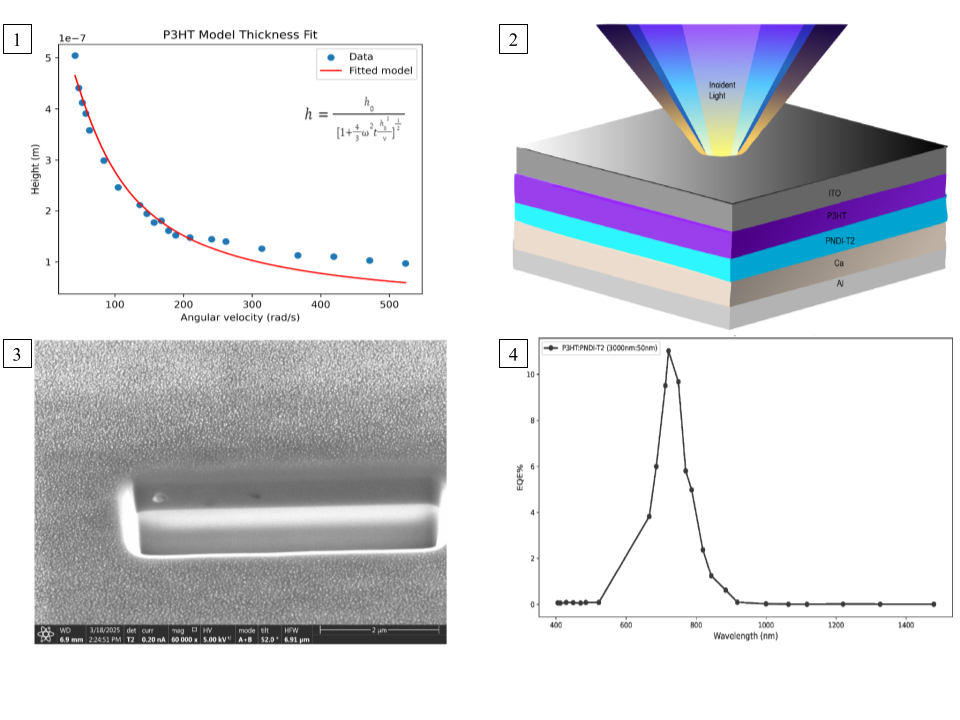
To demonstrate the potential of controlling polymer layer thickness, we have developed planar heterojunction organic photodetectors. These devices are capable of selective wavelength photodetection, with promising applications in areas such as night vision, heat vision, and more recently, biomedical fields like cancer cell detection and the identification of impurities in the bloodstream.
The photodetectors typically employ a blend of two distinct polymers to form small domains within the film. To block undesirable wavelengths, an optical filter is placed on top. However, the use of inorganic materials to produce these filters limits biocompatibility. In our novel approach, we propose using a planar heterojunction structure made of two different polymer films, without the need for domains. This creates a single interface between the polymers, with one polymer acting as the optical filter, making the devices fully organic and better suited for biological applications.
By precisely controlling the thickness of both films, we can enhance or block specific wavelengths through the cavity resonance effect. Therefore, precise control over film thickness is critical for achieving wavelength range selectivity in photodetection. Our work highlights the significance of developing a simple model for controlling polymer film thickness, one that is universally applicable across various semiconducting polymer applications.
Panel 1: Thickness Control Model Fitted to Raw Data
Panel 2: Schematic of Planar Heterojunction Organic Photodetector
Panel 3: SEM Image of Individually Stacked Polymer Film Layers
Panel 4: External Quantum Efficiency of Organic Photodetector Demonstrating Narrow Range Detection of Specific Wavelengths.