2025 AIChE Annual Meeting
(9j) Practical Framework for Assessing Performance of Quantum Simulation of Physical and Chemical Systems
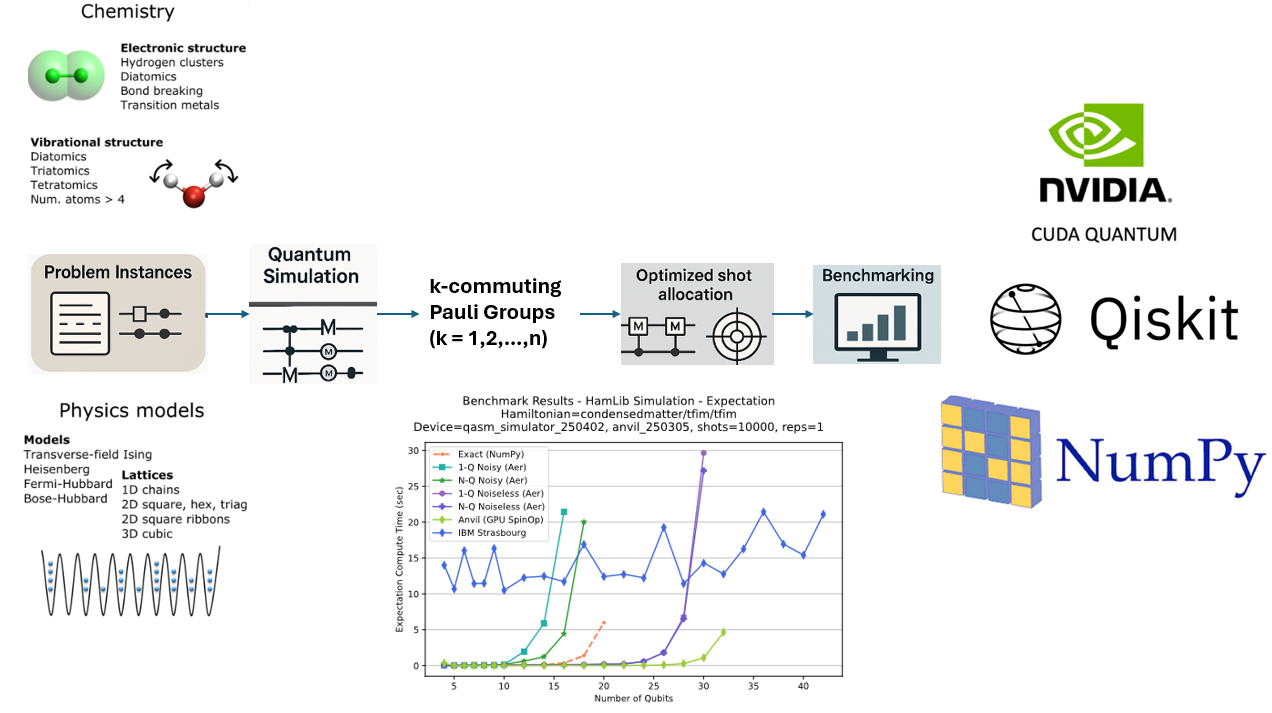
Our framework supports end-to-end demonstrations of algorithmic optimizations across a variety of quantum execution environments, enabling us to identify key factors that influence runtime and solution accuracy. We integrate these enhancements into the Quantum Economic Development Consortium (QED-C) Application-Oriented Benchmark suite (https://github.com/SRI-International/QC-App-Oriented-Benchmarks), leveraging problem instances derived from quantum Hamiltonians (which represent the total energy of a system as an operator, H) sourced from the open-source HamLib [3] collection. We perform Hamiltonian simulation —solving the underlying physical problem using different hardware and algorithms—on a range of models, including the Heisenberg model, Fermi-Hubbard model, Bose-Hubbard model, Transverse-Field Ising model, and molecular systems such as H₂, B₂, NH, and CH. Using a Trotterized quantum evolution approach, these simulations are executed on actual quantum hardware, emulated on classical CPUs via Qiskit Aer [5], and accelerated on GPUs using NVIDIA CUDA Quantum [4]. Additionally, we use exact diagonalization (NumPy [6]) as a classical benchmark for comparison.
Our results demonstrate notable trotter error reduction, which is the deviation from the exact values, using qubit-commuting measurement strategies combined with optimized shot allocation, which is validated both in simulations and on real quantum hardware. Notably, we employ the NVIDIA CUDA-Quantum [4] SpinOperator formalism to emulate these problem instances on GPUs, achieving significantly faster computations and near-linear scalability with increasing qubit counts—outperforming noisy quantum hardware computations, such as those on IBM Strasbourg, by up to a factor of three [5].
These findings highlight how targeted algorithmic optimizations can substantially improve performance on quantum hardware, even on today’s noisy intermediate-scale quantum (NISQ) devices. Our framework offers a valuable tool for guiding algorithm development and enables systematic evaluation of enhancements that help unlock the full potential of near-term quantum computing.
References:
[1] S. McArdle, S. Endo, A. Aspuru-Guzik, S. C. Benjamin, and X. Yuan, “Quantum computational chemistry,” Reviews of Modern Physics, vol. 92, no. 1, p. 015003, 2020
[2] Avimita Chatterjee, Sonny Rappaport, Anish Giri, Sonika Johri, Timothy Proctor, David E. Bernal Neira, Pratik Sathe, and Thomas Lubinski. A Comprehensive Cross-Model Framework for Benchmarking the Performance of Quantum Hamiltonian Simulations. 9 2024
[3] Nicolas PD Sawaya, Daniel Marti-Dafcik, Yang Ho, Daniel P Tabor, David E Bernal Neira, Alicia B Magann, Shavindra Premaratne, Pradeep Dubey, Anne Matsuura, Nathan Bishop, Wibe A De Jong, Simon Benjamin, Ojas D Parekh, Norm M. Tubman, Katherine Klymko, and Daan Camps. Hamlib: A library of Hamiltonians for benchmarking quantum algorithms and hardware. In 2023 IEEE International Conference on Quantum Computing and Engineering (QCE), volume 02, pages 389–390, 2023
[4] NVIDIA. Cuda quantum. https://developer.nvidia.com/cuda-quantum, 2024
[5] Ali Javadi-Abhari, Matthew Treinish, Kevin Krsulich, Christopher J. Wood, Jake Lishman, Julien Gacon, Simon Martiel, Paul D. Nation, Lev S. Bishop, Andrew W. Cross, Blake R. Johnson, and Jay M. Gambetta. Quantum computing with Qiskit, 2024
[6] Charles R. Harris, K. Jarrod Millman, Stefan J. van der Walt, Ralf Gommers, Pauli Virtanen, David Cournapeau, Eric Wieser, Julian Taylor, Sebastian Berg, Nathaniel J. Smith, Robert Kern, Matti Picus, Stephan Hoyer, Marten H. van Kerkwijk, Matthew Brett, Allan Haldane, Jaime Fernández del Rio, Mark Wiebe, Pearu Peterson, Pierre Gérard-Marchant, Kevin Sheppard, Tyler Reddy, Warren Weckesser, Hameer Abbasi, Christoph Gohlke, and Travis E. Oliphant. Array programming with NumPy. Nature, 585(7825):357–362, September 2020