2025 AIChE Annual Meeting
(57e) Polypropylene (PP) Thermolysis: A Feature x Population Balance Model (FxPBM)
Authors
Jiankai Ge - Presenter, University of Illinois at Urbana-Champaign
John B. Russell, Argonne National Laboratory
Samuel B. Hunt, Argonne National Laboratory
Uddhav Kanbur, Argonne National Laboratory
Magali Ferrandon, Argonne National Laboratory
David Kaphan, Argonne National Laboratory
Massimiliano Delferro, Argonne National Laboratory
Baron Peters, University of Iliinois
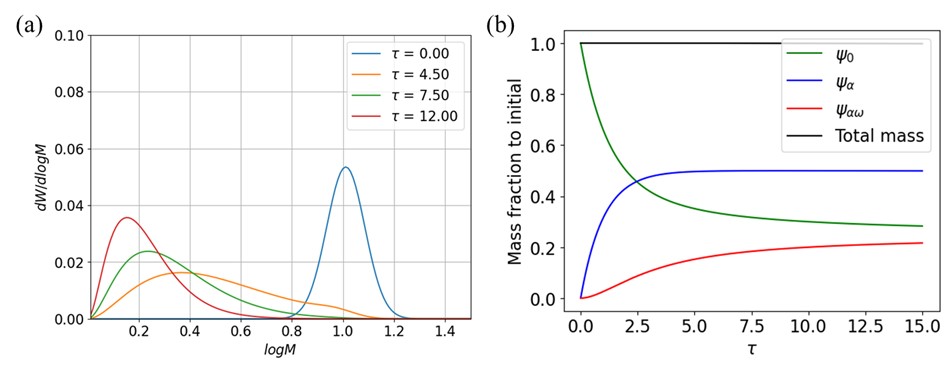
Based on current trends, 400 million tons of plastic is produced each year, and most of it will be landfilled, incinerated, or lost in the environment as pollution. Chemical recycling methods are being pursued to recycle plastic waste. Pyrolysis has the benefit of being applicable to mixed and contaminated plastic wastes. Product yields and selectivities from pyrolysis have previously been modeled with global conversion models, lumped kinetics models, and detailed mechanistic models. Detailed models are usually limited to modest molecular weights to limit the number of species. Population balance models (PBMs) offer an efficient way to model processes where the reactants have thousands of different molecular weights, but pyrolysis products and intermediates also exhibit different features. For example, pyrolysis of polypropylene (PP) proceeds via mixture of a-olefins, aw-olefins, and alkanes all many different molecular weights. We illustrate a feature x population balance modeling framework that retains the full microkinetic model detail, while also tracking the molecular weight distribution for level of dehydrogenation. By fitting the model to experimental data, we obtained rate constants for the elementary steps and compared them to estimates from prior ab initio estimates.