2025 AIChE Annual Meeting

(77i) Pilot-Scale Demonstration of Hydrogen Release from Liquid Organic Hydrogen Carriers (LOHCs) for Heavy-Duty Mobility Applications

Authors

Kariana Moreno-Sader - Presenter, University of Cartagena
Sayandeep Biswas, University of Minnesota
Ahmet Alper Yontar, Tarsus University
William Green, Massachusetts Institute of Technology
Medium- and heavy-duty trucks are major greenhouse gas (GHG) emitters, accounting for a quarter of U.S. transportation emissions despite comprising only 5% of vehicles on the road. To reduce emissions from long-haul trucking, several low- and zero-carbon fuel options are being explored, including battery-electric, compressed hydrogen, and liquid energy carriers. Our recent study shows that battery-electric trucks (BETs) with overnight charging are not well-suited for today’s long-haul trucking industry, as they require large, heavy, and expensive batteries to achieve the necessary daily range. Hydrogen-powered trucks also face challenges, as hydrogen must be transported either as a cryogenic liquid at 20K or as a compressed gas at 350 bars. The delivery and refueling process is highly energy-intensive, accounting for 60–80% of the delivered hydrogen cost at the pump. Both options incur a 2× price premium today compared to diesel and require substantial upfront infrastructure investments, which pose a significant barrier to widespread adoption. Liquid energy carriers, such as Liquid Organic Hydrogen Carriers (LOHCs), offer many advantages for long-haul trucking, as delivering energy as a liquid is easier and cheaper than through high-power electric chargers or as a gas.

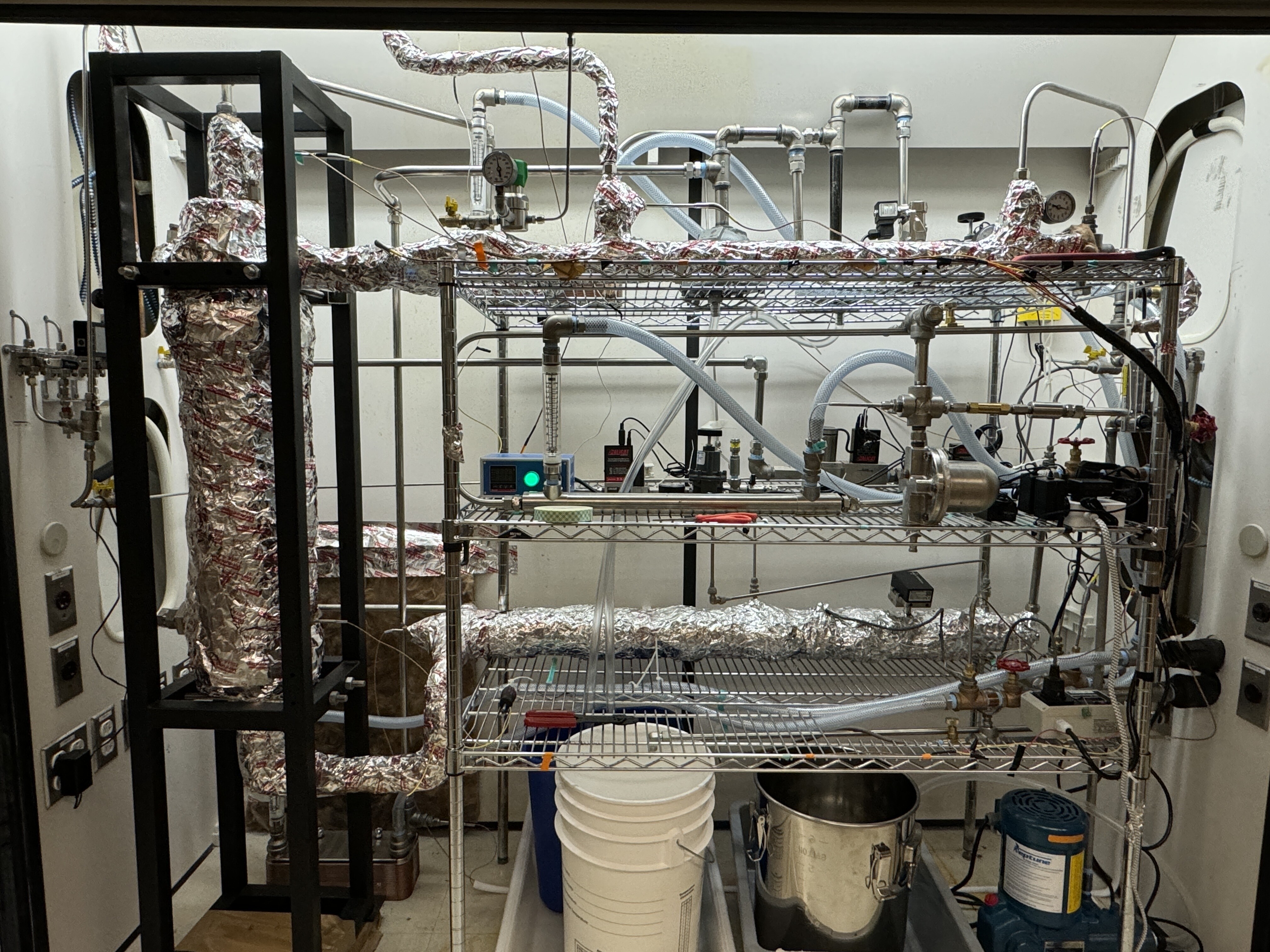
We previously presented a concept paper for a LOHC-powered truck, featuring onboard hydrogen release from perhydro benzyl toluene (H12-BT) molecules. This concept benefits from heat integration with the engine exhaust and eliminates the need for hydrogen compression. Therefore, we address the two key pain points in the existing LOHC supply chain for mobility applications. Using our system, the energy delivery efficiency is doubled, and further details can be found in Biswas et al. (2023). To demonstrate a functional prototype for LOHC trucks, we have designed and built a 12-kW pilot-scale hydrogen release unit (see Figure 1). This unit is tailored for mobility applications which require high volumetric power density and elevated hydrogen release pressure necessary for injection in a combustion engine. We achieved a power density of 200 kW/m3 at 285 °C and 5 bars, using the LHV of H2 to compute the power. This is higher than other designs reported in the literature and high enough to be practical on a big rig truck. Our comprehensive analysis using two-dimensional gas chromatography (GC×GC) of reactor outlet had no detectable amounts of undesired higher-boiling-point components, such as methyl-fluorene, suggesting the LOHC could be reused for many hydrogen load/release cycles.