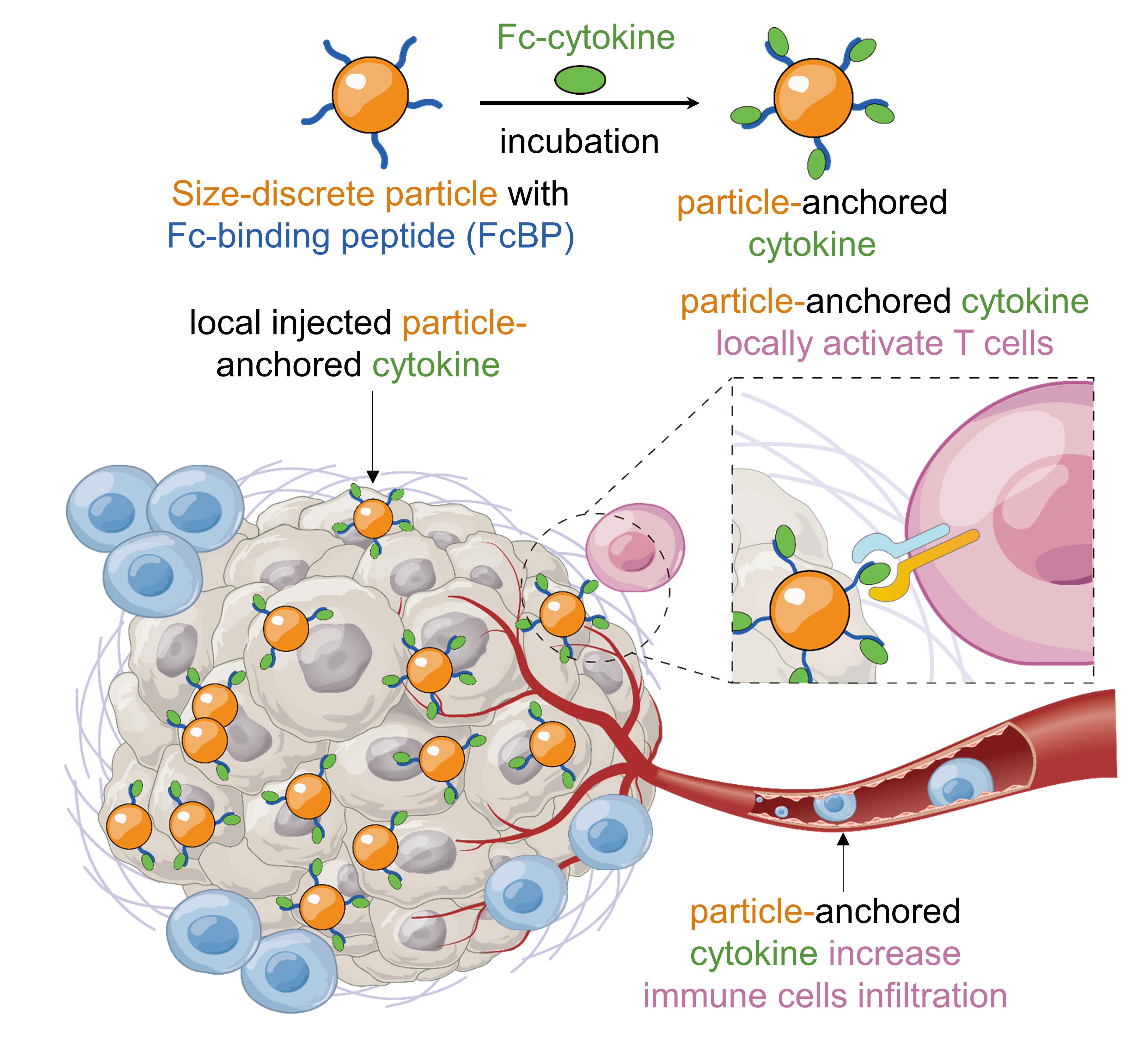
Preclinical studies demonstrate that immunostimulatory cytokines trigger anti-tumor immune responses, yet their clinical application remains constrained by severe immune-related adverse events following systemic administration. Tethering cytokines to soluble macromolecules such as poly(ethylene glycol) through conventional nonspecific bioconjugation techniques can extend the circulation half-time of conjugated cytokines but produces heterogeneous products with compromised structural integrity and activity; clinical trials of these conjugates (e.g., poly(ethylene glycol)–IL-2) have frequently been discontinued due to poor efficacy. Alternatively, local (intratumoral [i.t.]) administration of cytokines has been investigated as a strategy for maximizing their i.t. retention. However, injected cytokines (e.g., IL-2 and IL-12) enter the systemic circulation within minutes due to their low molecular weights (~10 kDa for IL-2, ~70kDa for IL-12). Furthermore, i.t. administration of cytokine-loaded nanoparticles fails to enhance cytokine retention in tumors. For example, 24 h after i.t. administration of 150-nm liposomes with IL-2-decorated surfaces, only ~20% of the liposomes remain in the tumor. Moreover, implantable delivery carriers such as scaffolds and hydrogels cannot prevent cytokines from rapidly entering the circulation within hours because the pores of these carriers (>1 µm) are significantly larger than cytokine molecules (<10 nm). To address these problems, here we present a straightforward, versatile approach for noncovalently anchoring potent Fc-fused cytokine molecules to size-discrete particles decorated with Fc-binding peptide for local delivery.
Upon intratumoral injection, particle-anchored Fc-cytokines show size-dependent retention within tumors. The 1-μm particles extend intratumoral retention of Fc-cytokines beyond one week with minimal systemic exposure, inducing anti-tumor immunity while eliminating the systemic toxicity associated with circulating cytokines. Furthermore, combining these particle-anchored cytokines with immune checkpoint blockade antibodies safely promotes tumor regression across various syngeneic and genetically engineered murine tumor models, including 4T1, B16F10, MMTV-PyMT tumors, while generating systemic anti-tumor immunity against tumor rechallenge. This formulation strategy provides a safe, tumor-agnostic approach that separates cytokines' immunostimulatory benefits from their systemic toxicities, offering potential for clinical translation (Sci. Adv.10,eadk7695(2024)).