2025 AIChE Annual Meeting
(494g) Oxygen-Induced Structural Disruption in Ultrathin Carbon Membrane for High-Performance Hydrogen Separation
Authors
Kumar Varoon Agrawal, École Polytechnique Fédérale De Lausanne (EPFL)
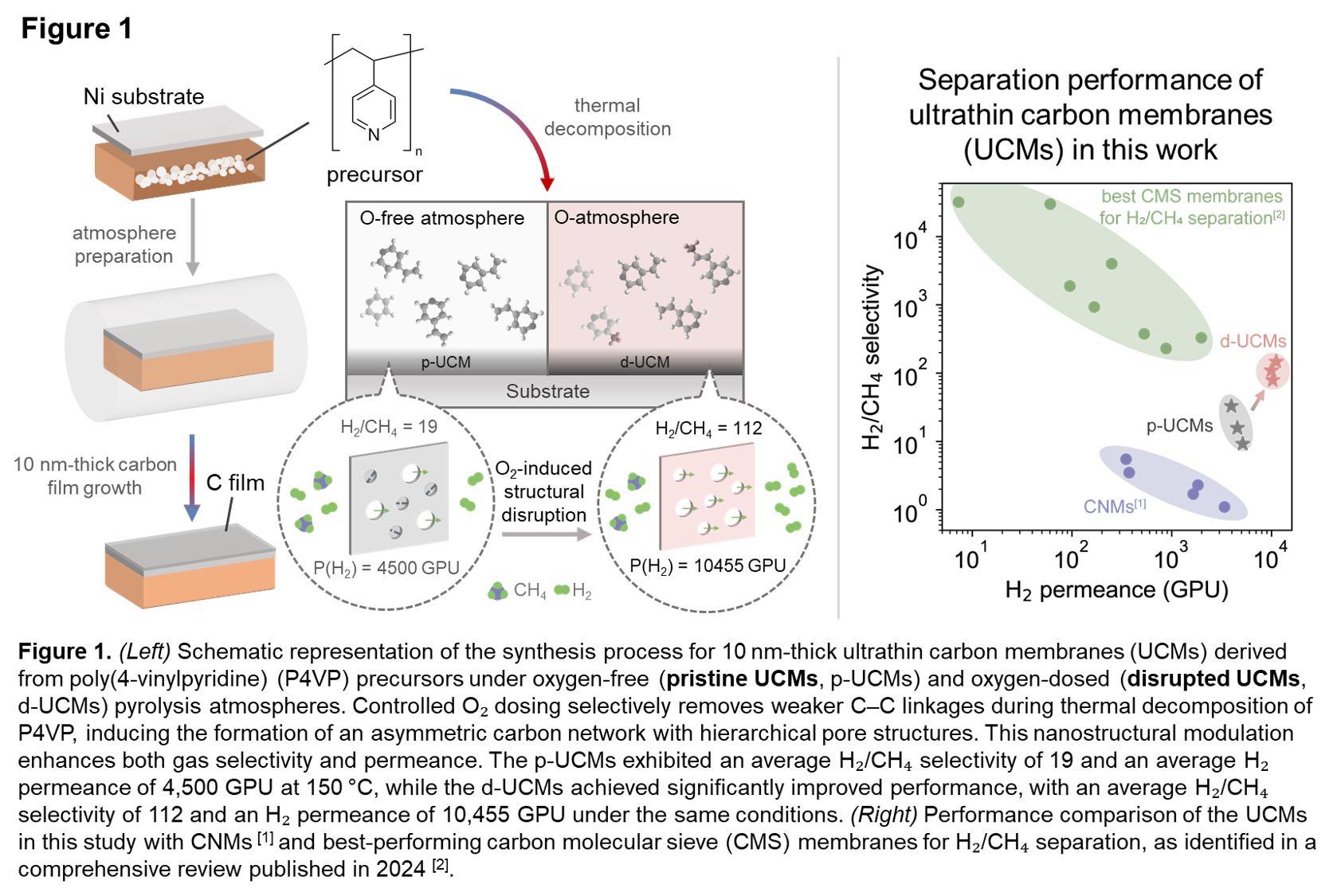
Ultrathin carbon membranes are attractive for gas separation due to their high permeance but are typically limited by low selectivity. We report a new class of disrupted ultrathin carbon membranes (d-UCMs), sub-10 nm thick films synthesized via oxygen-assisted pyrolysis of poly(4-vinylpyridine) (P4VP) on nickel substrates. Controlled oxygen exposure modifies the carbonization process, yielding a nanostructure with disordered domains and hierarchical porosity. This structural disruption enables a rare combination of high hydrogen selectivity and permeance, overcoming the conventional trade-off in membrane design. Spectroscopic and structural analyses reveal that oxygen does not act as a dopant but instead reshapes the carbon framework by removing weak linkages while preserving nitrogen-rich motifs. The resulting membranes exhibit stable performance at elevated temperatures. This work presents a general strategy for tuning nanostructure in ultrathin carbon films via reactive atmosphere control, effectively bridging the gap between conventional carbon molecular sieve and carbon nanomembrane technologies.
Reference
[1] Ai, M.; Beyer, A. Advanced Materials 2014, 26: 3421-3426
[2] Genduso, G.; Ogieglo, W.; Wang, Y.; Pinnau, I. Journal of Membrane Science 2024, 699, 122533.