2025 AIChE Annual Meeting
(696a) Organic Mixed Ionic-Electronic Conduction in Polymer Electrodes for Batteries
Author
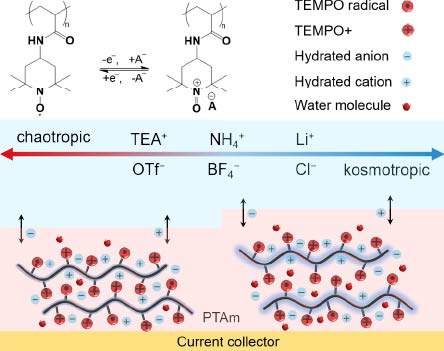
Redox-active polymers are essential for emerging applications in batteries, pseudocapacitors, sensors, and neuromorphics. Upon reduction or oxidation, these polymers change in state of charge and electronic conductivity as they are compensated by complementary ions or dopants. The complementary and simultaneous transport of electrons and ions marks these materials as mixed conductors or OMIECs (organic mixed ionic-electornic conductors). This concerted and complex reaction involves multiple components, multiple steps - ultimately leading to challenges in predicting and understanding structure-property relationships in OMIECs. Here, the mechanisms and concepts are OMIECs are discussed in the context of organic batteries. Specifically, quartz crystal microbalance with dissipation monitoring (QCMD) is used to monitor mixed conduction processes in real time, as the technique is applied during cyclic voltammetry, galvanostatic cycling, and even impedance spectroscopy. It is revealed that the polymers volumetrically "breathe", expanding and contracting during each charge-discharge cycle as ions and solvent molecules ingress and egress. It is shown that this swelling process is strongly correlated to performance, in which excessive swelling removes interchain contacts for electron transfer. A data-science enabled approach further leads to prediction of polymer chemistries that control these processes, in which polymer-solvent-ion interactions are considered. Overall, these efforts will lead to organic batteries with improved energy densities and stabilities.