2025 AIChE Annual Meeting
(508c) Optimizing Structured Sorbent Laminates for DAC Via Standard Analytical Methods and Novel Technoeconomic Heuristics
Here we present a mathematically simple yet robust TEA to evaluate and optimize structured sorbent laminates for DAC applications. Our model relies on standard analytical techniques, allowing for rapid design iteration of structured sorbent laminates. We employ a range of test conditions which may be adopted across industry for increased standardization. We identify a series of analytical experiments to characterize structured sorbent laminates and present results of leading constructions. Using computationally inexpensive models, we extrapolate the performance of these laminates into a range of DAC conditions, including optimization scenarios across environments (e.g., local grid CO2 footprint) and processes (e.g., desorption conditions and subsequent oxidation rates).
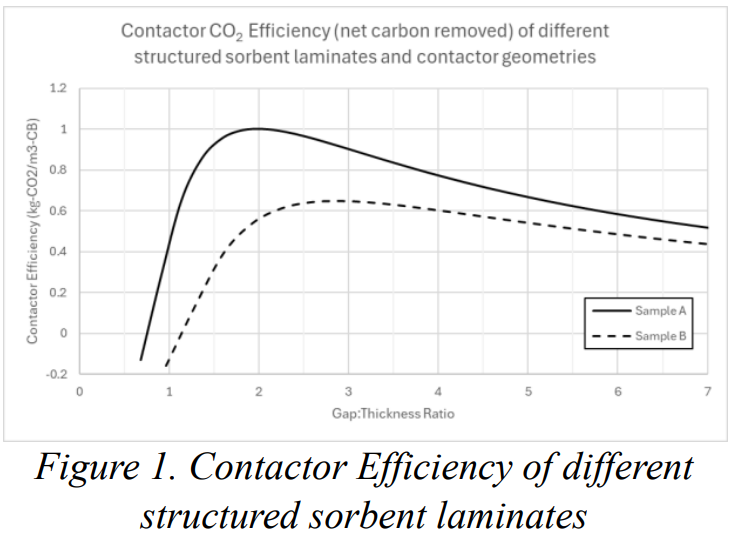
From these models, we quantify known sorbent advantages, such as cyclic working capacity and oxidation rate. We demonstrate material performance based on local environments and processes. We identify the requirement to optimize structured sorbent laminates considering contactor geometries. Finally, we quantify improvements across several generations of materials, and we propose critical properties of structured sorbent laminates to continue advancing the DAC industry.