2025 AIChE Annual Meeting
(619h) Optimizing MR-Guided Focused Ultrasound: Role of Superparamagnetic Iron Oxide Nanoparticles in Enhancing Image Contrast
Authors
Nathan Sambo, Virginia Tech
Eli Vlaisavljevich, Virginia Tech
Craig H. Meyer, University of Virginia
Steven Allen, Brigham Young University
Richey Davis, Virginia Tech
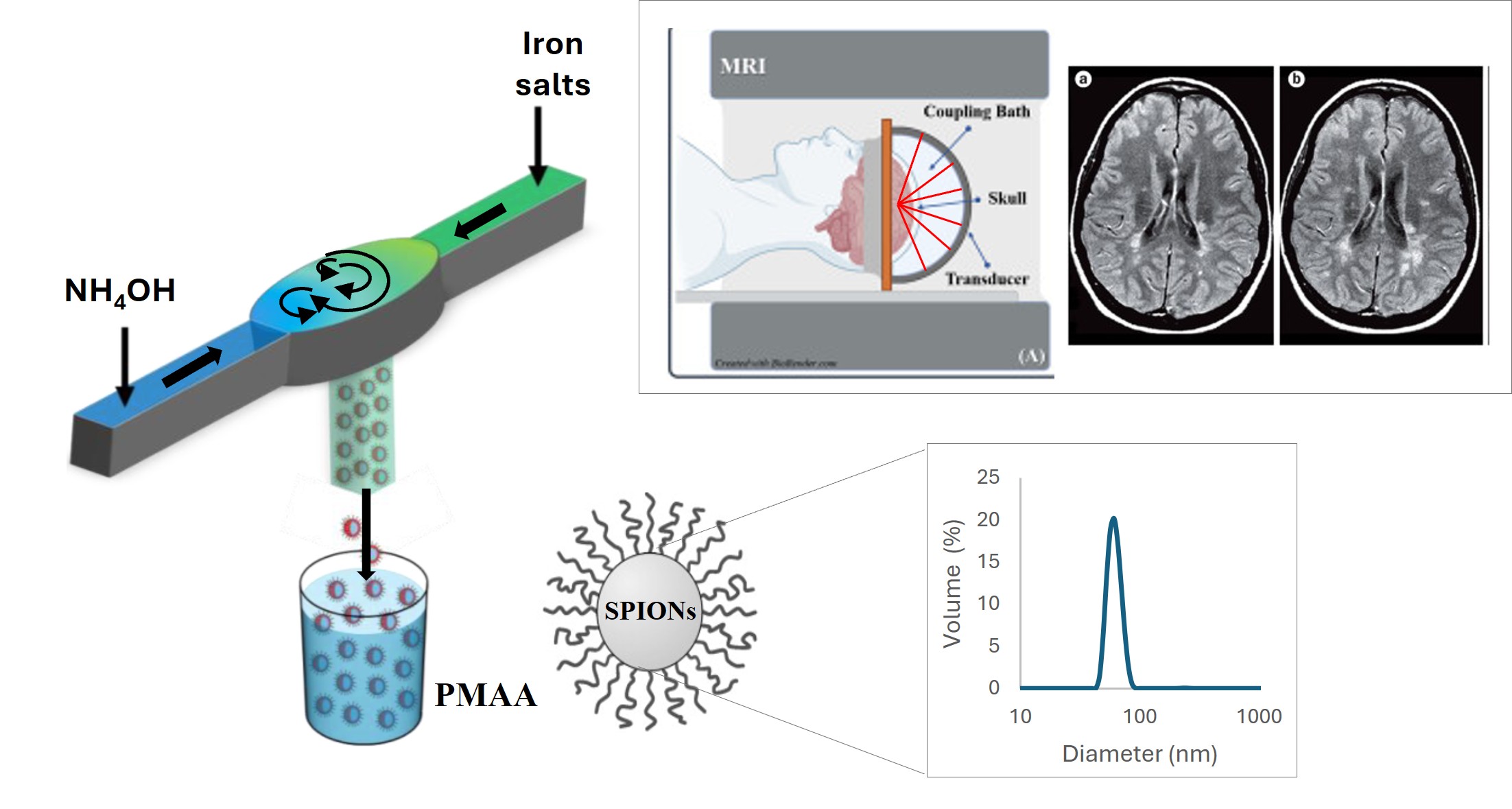
MR-guided focused ultrasound (MRgFUS) is an advanced medical technology that uses focused ultrasound waves, directed by magnetic resonance imaging (MRI), to accurately treat targeted tissues or areas in the body without requiring invasive surgery. To effectively transmit focused ultrasound (FUS) from the piezoelectric generators into the body, an acoustic coupling bath—preferably filled with water—is required. However, the MR signal from the bath water interferes with the signal from bodily tissues, significantly reducing the resolution of the MR images. To address this issue, superparamagnetic iron oxide nanoparticles (SPIONs) are introduced into the aqueous acoustic coupling bath. These nanoparticles accelerate the relaxation rate of protons in the bath water, distinguishing them from the protons in bodily tissues and enhancing image contrast. This research focuses on (1) scaling up the synthesis and filtration of SPIONs surface-functionalized with poly(methacrylic acid) (PMAA) and (2) characterizing SPIONs, which early studies indicate can significantly enhance MR image resolution while preventing unwanted cavitation in the bath. Dynamic light scattering (DLS), nanoparticle tracking analysis (NTA), and transmission electron microscopy (TEM) were used to determine the size distribution of SPIONs. The efficiency of tangential flow filtration (TFF) was assessed using thermogravimetric analysis (TGA). Magnetite production was confirmed by X-ray diffraction (XRD), and longitudinal and transverse relaxivities were calculated using nuclear magnetic resonance (NMR). It was concluded that using a clinical concentration of SPIONs can reduce the transverse relaxation time to less than 3 ms. The results indicate that an increase in nanoparticle size enhances relaxivities up to a maximum value. Since the interfacial tension of nanocolloids can influence the cavitation threshold, it was measured using the pendant-drop method. The findings showed that SPIONs at clinical concentrations do not affect the cavitation threshold.