2025 AIChE Annual Meeting
(258g) Optimized Scaling of Biomass-Based Carbon Dioxide Removal Systems
Authors
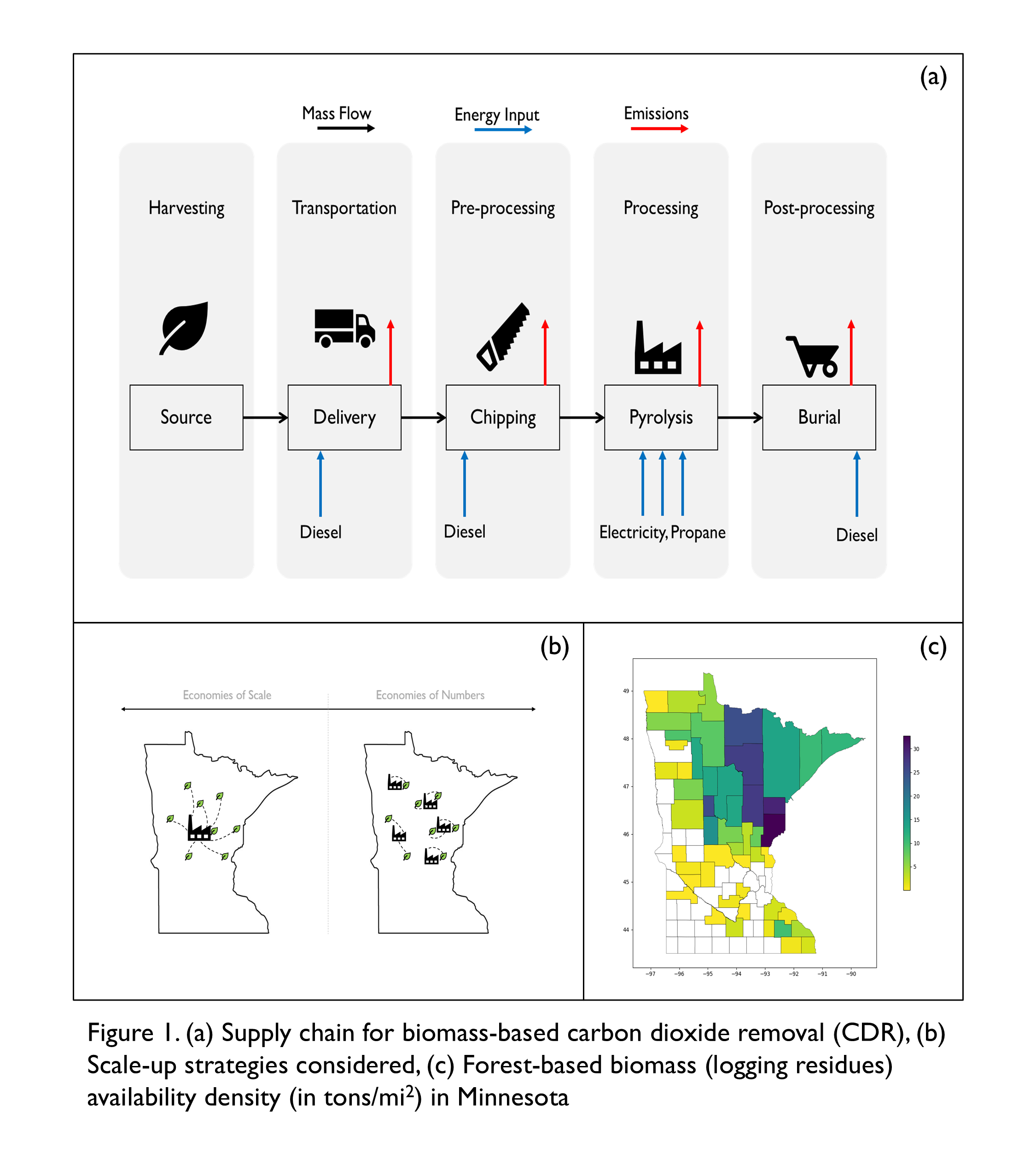
In this work, we focused on four CDR technologies that convert biomass to carbonaceous residues or char using pyrolysis.[5] A general mass and energy balance was developed to explore a range of different operating conditions to quantify the yield and composition of the char generated, the energy required by the process, and the net CO2 captured by the process. This balance was integrated with pre-processing, transportation, and post-processing requirements, such as burial, by using a Mixed Integer Linear Programming (MILP) model to determine the size and location of facilities. This model was applied as a case study in Minnesota for utilizing forest-based logging residues as CDR input. Two different scale-up strategies were compared: (i) a single large centralized facility, and (ii) many smaller distributed facilities. The annual cost of operation and annual CO2 removal for different scenarios was calculated to identify trade-offs associated with system decisions. Furthermore, the sensitivity of model parameters including the quality of incoming biomass and economic values of inputs and outputs was evaluated to demonstrate opportunities for these technologies to be competitively deployed and remove atmospheric CO2 at the required scales.
[1] A. Usadi, M. Higgins, and B. Mignone, "President's Page: Emerging CO2 removal options require geoscience skills," The Leading Edge 43, (2024).
[2] J. K. Soeherman, A. J. Jones, and P. J. Dauenhauer. “Overcoming the entropy penalty of direct air capture for efficient gigatonne removal of carbon dioxide”. In: ACS Engineering Au, 3, 2, (2023).
[3] K.Z. House, A.C. Baclig, M. Ranjan, E.A. van Nierop, J. Wilcox, and H.J. Herzog. “Economic and energetic analysis of capturing CO2 from ambient air”. In: Proceedings of the National Academy of Sciences, 108, (2011).
[4] W. A. Marvin, L. D. Schmidt, and P. Daoutidis. “Biorefinery Location and Technology Selection Through Supply Chain Optimization”. In: Industrial & Engineering Chemistry Research, 52 (2013)
[5] D. Neves, H. Thunman, A. Matos, L. Tarehlho, and A. Gomez-Barea. “Characterization and prediction of biomass pyrolysis products”. In: Progress in Energy and Combustion Science, 37, (2017).