2025 AIChE Annual Meeting
(30a) Optimization of Calcination Techniques for Enhanced Material Properties in Electrode and Electrolyte Powders for Solid Oxide Electrolysis Cell (SOEC) Production.
Authors
Introduction
This research aims to enhance the efficiency and performance of Solid Oxide Electrolysis Cells (SOECs) by optimizing the synthesis and characterization of powders. Our primary focus is on the cathode material. La Sr Co Fe (LSCF), a perovskite material synthesized using solid-state methods. By comparing microwave heating with conventional methods, we aim to identify the most effective approach for improving material properties. This will be achieved through material characterization with a particular emphasis on achieving phase purity through innovative microwave calcination techniques. Characterization techniques include X-ray Diffraction (XRD) analysis, which provides significant insights into the crystalline structure of the synthesized powders. Additional characterization methods such as Brunauer-Emmett-Teller (BET) surface area analysis, Scanning Electron Microscopy (SEM), and Inductively Coupled Plasma Mass Spectrometry (ICP-MS) have been utilized to further understand the material properties. Furthermore, Electrochemical Impedance Spectroscopy (EIS) will be conducted to evaluate the electrochemical properties of the materials, providing a comprehensive understanding of their performance in SOEC applications. This study not only explores a diverse range of materials and synthesis techniques but also aims to provide an in-depth understanding of their impact on the performance of electrochemical systems.
Methodology
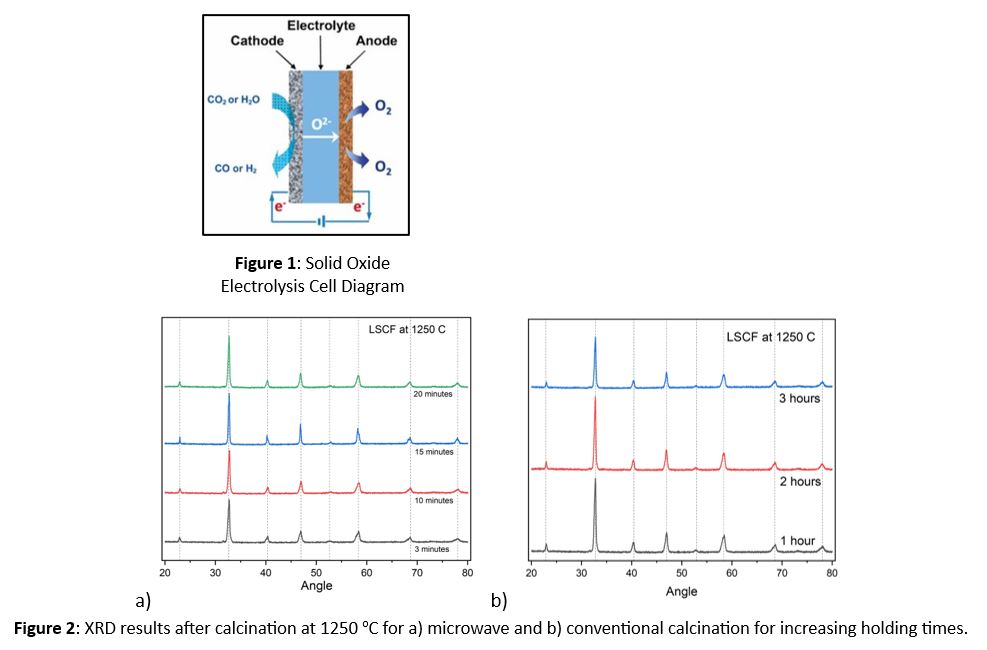
The synthesis of Lanthanum Strontium Cobalt Ferrite (LSCF) powders was conducted using solid-state synthesis, with carbonates serving as precursors. The calcination process employed a susceptor-insulation-package (SIP), which facilitated dual heating mechanisms: internal heating through microwave coupling and external heating via a silicon carbide susceptor. This innovative approach allowed for efficient and uniform heating of the material. Following the synthesis, various characterization techniques were employed such as XRD analysis provided significant insights into the crystalline structure, as illustrated in Figure 2, which presents the results of various microwave-calcined samples at increasing holding times.
Results
The XRD data revealed that the microwave-calcined LSCF powders achieved a high degree of phase purity. However, a small peak around the 32-degree mark indicated the presence of a potential secondary phase, identified as Lanthanum Oxide (LaO). This impurity suggests that while the microwave calcination method is effective, there are still challenges to be addressed in achieving complete phase purity.