2025 AIChE Annual Meeting
(164a) OH- Selective Membranes to Reduce Carbonate Crossover in CO2-Electrolysis
Ion exchange membranes (IEMs) play a pivotal role in the energy transition, to recover valuable products and to separate reactions for synthesis of sustainable fuels and chemicals. Intensive research on materials for IEMs identified a trade-off between selectivity and permeance by charge density tuning, thereby intrinsically challenging to improve both properties.
Alkaline CO2 electrolysis has recently been investigated as it suppresses the competing hydrogen evolution reaction at the cathode and would ideally enable the use of Ni-Ox catalysts at the anode instead of precious metal catalysts such as iridium or ruthenium oxide. However, because of acidification of the anolyte by carbonate (CO32-) crossover, the use of these alternative catalysts is not possible. Furthermore, carbonate crossover causes up to 50 % reactant loss as the carbonate gets re-oxidized at the anode and has to be separated from oxygen afterwards.
Thin-film-composite (TFC) IEMs recently have been successfully applied for specialty separations. However, none of these works target OH- selectivity. Research in our lab revealed that coating a standard anion-exchange-membrane (AEM) (providing conductivity and mechanical support) with a layer of polyamide (providing size-selectivity), blocks all counter-ions except for the smallest one, OH- . Such a carbonate rejecting membrane could prevent carbonate crossover, therefore overcoming a major issue that is currently holding back the scale up of alkaline CO2 electrolysis.
Methodology
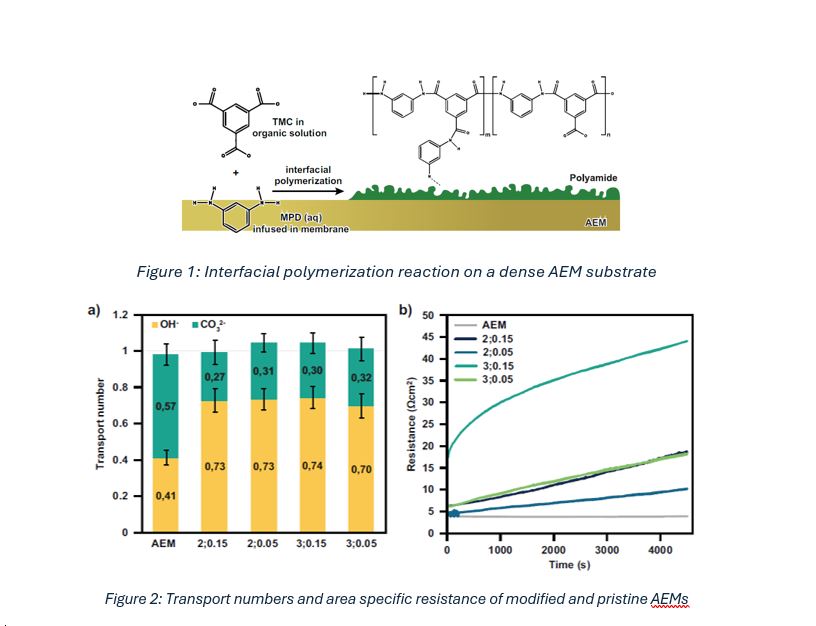
Commercially available AEMs (Sustainion/Selemion) were coated with an ultra-thin polyamide layer (PA) by interfacial polymerization (IP) using m-phenylenediamine (MPD) and Trimesoylchloride (TMC) as shown in Figure 1. By tuning the concentration of reactants, the reaction time and using additives like surfactants, the properties of the layer like pore size and thickness can be tuned.
Another approach was investigated in which the support layer of commercially available reverse osmosis (RO) or nanofiltration (NF) membrane was impregnated with ionomer to essentially achieve a similar TFC-membrane structure.
The fabricated membranes were tested in a six compartment cell to determine transport numbers of different anions and ionic resistance. Additionally, SEM images were taken to characterize the membranes in terms of surface morphology and layer thicknesses.
Additionally, a COMSOL model was used to verify whether a selective layer is a valid approach to reduce or prevent carbonate ions from crossing the anion exchange membrane.
Results
Our proof-of-concept demonstrates a successful thin-film-composite membrane with a polyamide layer of <200 nm on an anion exchange membrane substrate. Initial results show an up to 30-fold increase in ionic resistance in carbonate electrolyte versus KOH solution for coated Selemion substrates. The transport number of hydroxide and carbonate was determined via titration of the electrolytes, showing a clear increase of hydroxide as transported species for coated membranes vs uncoated membranes. The overall resistance of the membranes is relatively high and increases with the addition of a polyamide layer, however, to combat this, the fabrication method was optimized and more conductive AEM substrates like Piperion and Sustainion were used.
Unfortunately, the results of electrochemical testing of coated Sustainion and Piperion membranes are fluctuating strongly, suggesting that the membranes made via interfacial polymerization on an AEM support suffer from defects in the polyamide layer.
The results of impregnated RO and NF membranes are much more consistent, however, results suggest that both anions are blocked from crossing the selective polyamide layer. This results in a strongly asymmetrical polarization curve when measuring the membrane in KOH or K2CO3, suggesting that the coated RO/NF membranes behave like ionic diodes.
The results of the COMSOL model suggest that even with a layer that has a OH- over carbonate and bicarbonate selectivity of a factor 1000, the preferred charge carrier across the membrane is still (bi-)carbonate. Additionally, there is a massive buildup of carbonate anions, increasing the diffusion driving force for carbonates to cross and decreasing the effectivity of the selective layer. Another concern is that, if the carbonate anions cannot carry the charge through the membrane, there are not enough hydroxide anions in the electrolyte to conduct the charge as hydroxide anions would immediately react with the CO2 that is being fed via the gas diffusion electrode to form carbonates.