2025 AIChE Annual Meeting
(591m) Numerical Modeling of Hybrid SOFC System with Inline Autothermal Reforming for High Power-Density Operation Scenarios
Authors
Yifan Gu, Colorado School of Mines
Fuqiong Lei, Oregon State University
Cyrus Boushehri, Colorado School of Mines
Tyrone Vincent, Colorado School of Mines
Gregory Jackson, University of Maryland
Robert Braun, Colorado School of Mines
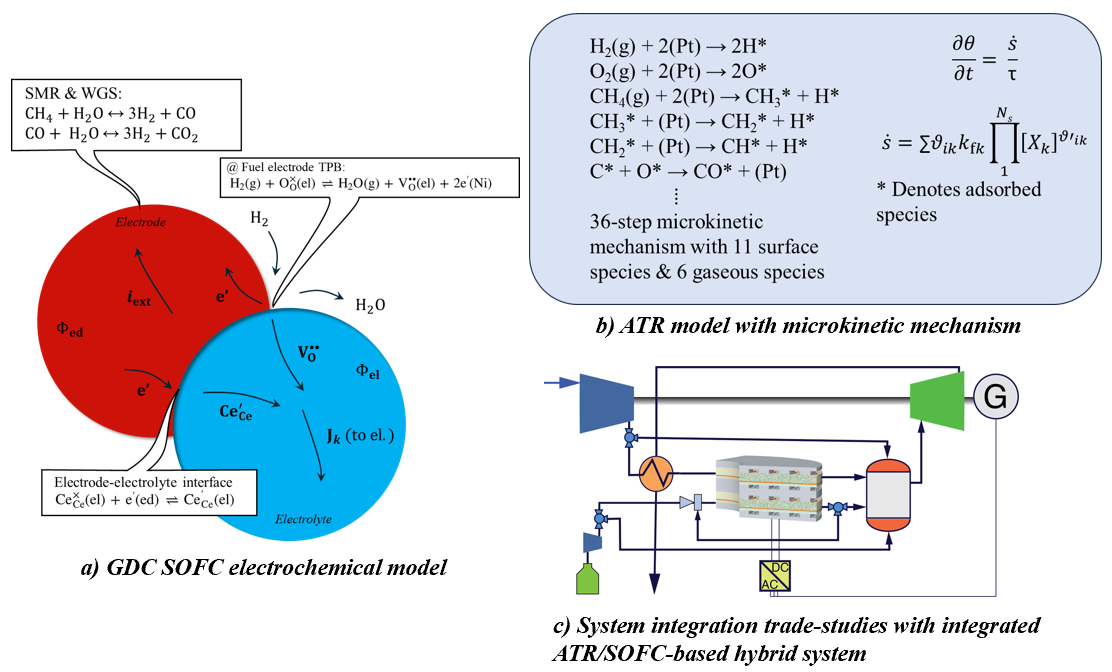
Solid oxide fuel cells (SOFC) offer high energy conversion efficiencies fuel flexibility, and the potential for high power densities, which makes them promising for application in the transportation sector. In this work, an SOFC-gas turbine hybrid system concept is developed and investigated for high power density applications. The hybrid system concept includes an integrated autothermal reformer (ATR) and heat exchanger to preheat the inlet SOFC gases. A system model combines a multiscale SOFC simulation and an ATR model with thermodynamic balance-of-plant component models. The SOFC model is based on a high power-density gadolinia doped-ceria electrolyte (GDC) based architecture and is validated based on electrochemical polarization data collected between 500-650°C. The model couples defect thermochemistry, charge transfer kinetics and porous media transport and captures the effect of mixed ionic-electronic conducting behaviour of the GDC membrane. The ATR model to evaluate catalytic reforming rates of CH4 based on an established thermodynamically consistent microkinetic mechanism. The modelling framework thus allows for a detailed examination of the intricate coupling between mass, heat and charge transport, as well as the electrochemistry and thermo-catalytic mechanisms. The simulations reveal the requirement of high excess air flows () through the cathode side to sustain average temperature gradients below 15 K cm-1. The results indicate that careful selection of operating conditions that maintains residual CH4 concentrations in ATR exhaust is advantageous, as it also facilitates internal reforming within the fuel cell. In this way, uniform temperature distributions can be sustained within the cell structure that enhance durability and prevent thermomechanical failure. System level parametric trade studies show the effects of operating conditions of voltage and fuel utilization on the system performance, whereby energy conversion efficiencies of over 60% are predicted for an integrated SOFC system with anode gas recycle. The integrated architecture can lead to effective thermal integration of the SOFC with compressor feedstocks reducing system complexity. Ultimately, such system concepts can enable the development of high specific power (kW/kg) SOFC systems and accelerate their adaptation into the transportation sector.