2025 AIChE Annual Meeting
(3ny) Ni-Based Heterogenous Catalyst Design for Decarbonization
Author
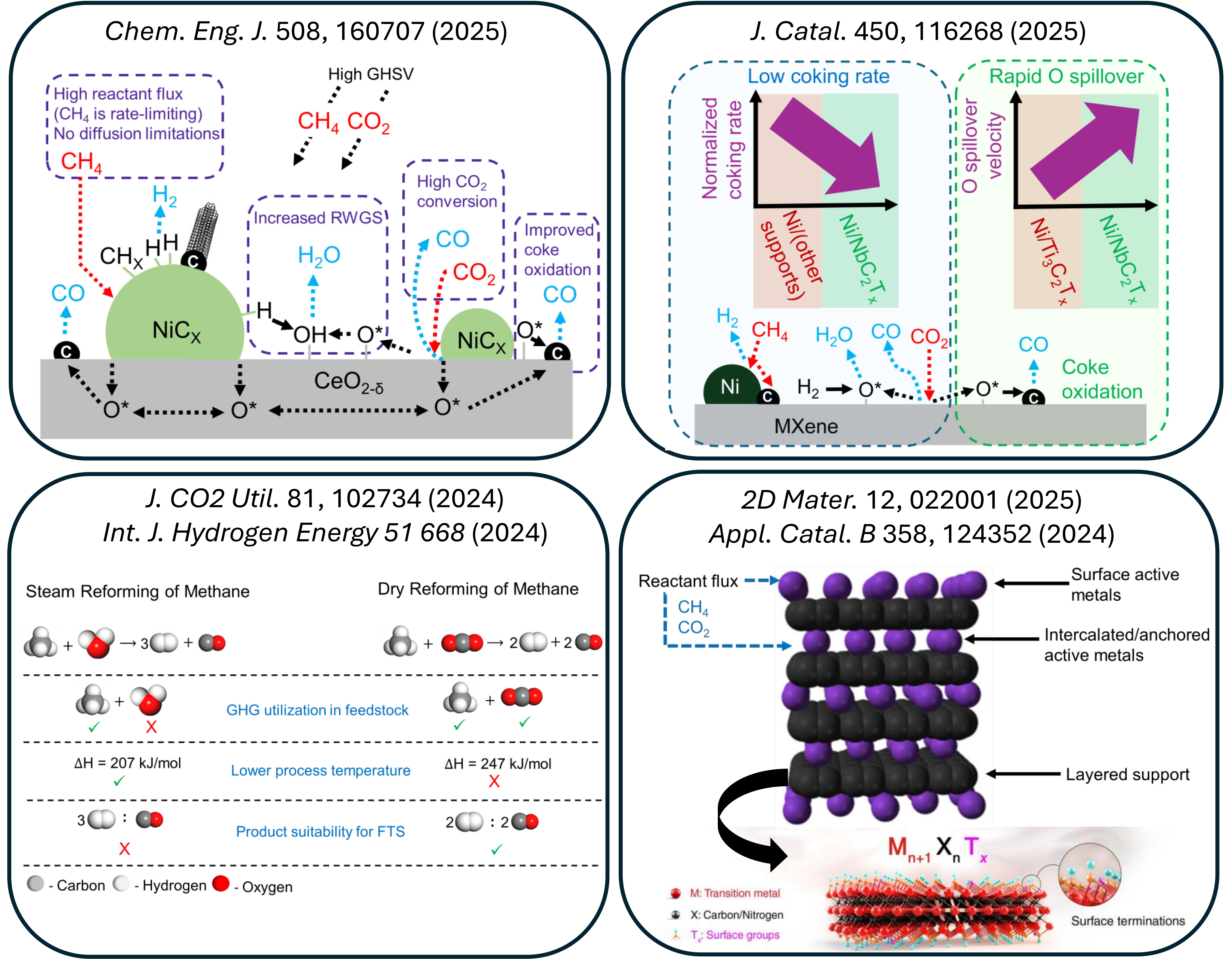
The goal of my research is to design Ni-based heterogeneous catalysts at the meso and nanoscale for decarbonization processes. These processes aim to achieve "net-zero" emissions and mitigate the greenhouse effect. Methane catalytic pyrolysis (MCP) and dry reforming (DRM) are two reactions that convert methane into hydrogen and syngas, respectively. My current PhD research in Prof. Placidus Amama’s group at K-State focuses on exploiting the unique properties of different supports to address challenges in MCP and DRM. We are also interested in synthesizing low-dimensional materials like CNTs and MXenes, and utilizing them in catalyst design. Properties such as surface area, reducibility, layered morphology, and amphoteric nature are useful to address challenges in MCP and DRM.
My work on DRM revealed that the interplay of CeO2 reducibility and thermodynamics effect under industrial conditions can reduce Ni coking and alter product selectivity. Thiele-modulus (ϕ), effectiveness factor (η), and Weisz–Prater criterion (CWP) were used to confirm the absence of internal diffusion limitations in the catalysts. In another study, the efficient use of oxygen in coke oxidation was revealed to be dependent on its rapid spillover on Ni/Nb2CTx, a phenomenon dependent on its conductive nature. Time-resolved mechanistic insights into atomic-scale oxygen dynamics were derived showing spillover velocity of 96.9 Å/ps at reaction conditions. In another ongoing investigation, we revealed that exsolution in NiCr2O4 spinel leads to anchored Ni catalyst on reducible and amphoteric Cr2O3 support which yields high H2/CO and low coking rate. My work on MCP revealed that Ni/graphite catalyst do not require pre-reduction and can achieve high and stable methane reaction rates.
I am currently collaborating with other groups working on molecular dynamics and x-ray absorption studies to provide a deeper understanding of the mechanism involved in these reactions. I believe by combining materials development, simulations, and high throughput experimentation, we can fast-track the lab-to-industry transition of MCP and DRM. Moving forward, I aim to leverage my skillsets to experimentally design next-generation catalysts that can drive decarbonization on an industrial scale.
Teaching Interests
I am passionate about teaching and eager to become a more effective teacher through comprehensive preparation, real-world examples, and interactive techniques. As a graduate student at Kansas State University, I have served as a teaching assistant for CHE 550 Chemical Reaction Engineering, CHE 531 Transport Phenomena II, and CHE 521 Chemical Engineering Thermodynamics II. My responsibilities included grading and feedback, holding office hours and student support, leading discussions, etc. I have also mentored three undergraduate students in their team Design Project.
I was a lecturer at Nnamdi Azikiwe University, Nigeria, for two years before starting my Ph.D. studies. There, I taught CHE 535 Separation Processes IV, CHE 431 Separation Processes III, and CHE 344 Chemical Engineering Thermodynamics. I also supervised bachelor’s degree thesis research for four students in water treatment and thermodynamic analysis.
Service
I currently serve as an academic editor on the editorial boards of the following journals, where I manage manuscript submissions and oversee the peer review process.
- Advances in Materials Science and Engineering (Wiley Online Library)
- Scientific Reports (Nature Portfolio)
- PLOS Water (PLOS)
Image caption: Summary of research output on catalyst design for methane reforming.