2025 AIChE Annual Meeting
(302f) A New Mechanistic Model to Evaluating Fouling in Single-Pass Tangential Flow Filtration at Constant Flux
Authors
Single-pass tangential flow filtration (SPTFF) is increasingly used in biopharmaceutical manufacturing, due to its ability to continuously concentrate biomolecules while minimizing hold-up volume and shear stress-induced protein aggregation. However, its susceptibility to fouling can impact performance, requiring predictive tools to optimize the process conditions. While existing models can describe fouling well for batch TFF under constant pressure conditions, there is limited understanding of how fouling progresses under constant flux in SPTFF.
Fouling in SPTFF can arise from multiple mechanisms, including pore blockage and cake formation, both of which influence transmembrane pressure (TMP) evolution. At lower fluxes, fouling may be dominated by pore blockage, while at higher fluxes, cake formation becomes more prominent, due to increased protein accumulation on the membrane surface. The extended channel length of the SPTFF unit, results in fouling varying spatially along the membrane, with higher concentrations and lower cross flow velocity occurring near the retentate outlet, leading to greater fouling at this end of the filtration module. A key challenge in SPTFF is understanding how process parameters, such as protein concentration, feed flow rate and volumetric concentration factor (VCF) impact the progression of fouling. Traditional models often assume uniform conditions along the membrane, which may not accurately capture localized fouling behavior.
Experimental Approach
To examine the progression of fouling, SPTFF experiments were conducted using whey protein isolate (WPI) solutions filtered through a 10 kDa polyethersulfone (PES) membrane. The system operated under constant flux conditions of 25 litres/m2.hr (LMH) and 50 litres/m2.hr (LMH), with a concentration factor of 10, allowing for an assessment of fouling differences at varying permeate flow rates. Pressure sensors monitored TMP evolution, while real-time protein concentration measurements ensured system stability under conditions of constant flux. Additionally, membrane performance was assessed before and after filtration, using normalized water permeability (NWP) testing to determine the extent of irreversible fouling.
A mechanistic model was developed based on the SPTFF model (without fouling) developed by Jabra et al. [1]. This was coupled with expressions developed by Kirschner et al [2] for both pore blockage and cake filtration under conditions of constant flux but at constant protein concentration.
Results
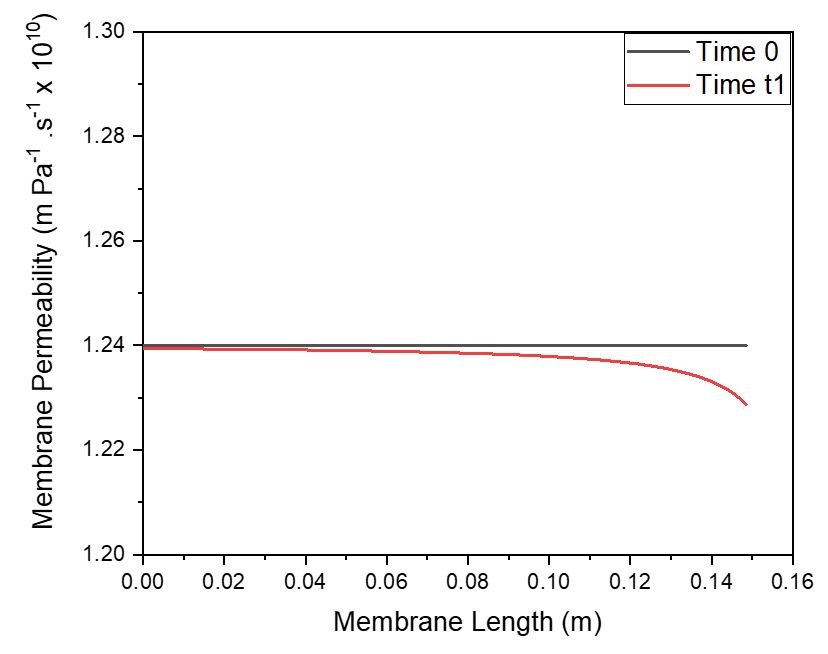
Experimental findings indicated that fouling behavior in SPTFF was highly dependent on operating flux. At 25 LMH, the rate of transmembrane pressure rise remained largely unaffected by variations in feed protein concentration and flow rate. In contrast, at 50 LMH, a more rapid increase in TMP was observed. The mechanistic model indicated significant spatial variation in fouling, with the highest pressure drop occurring near the module outlet and fouling gradually decreasing toward the inlet (Figure 1). This trend aligned with protein accumulation along the membrane length. As retained proteins built up, membrane resistance increased, accelerating the transition from pore blockage to cake formation.
Figure 1 – the variation in membrane permeability along the membrane length at time =0 and time = 1 showing how fouling is more pronounced at the retentate outlet due to higher protein concentration and lower crossflow velocity
Conclusion
Fouling remains a major limitation in SPTFF, impacting both process efficiency and membrane longevity. This study identifies the key factors affecting fouling progression under conditions of constant flux, with a particular focus on spatial variations along the membrane length. While further refinement is needed to fully characterize these effects, the insights gained provide a foundation for optimizing SPTFF operation in biopharmaceutical manufacturing. By leveraging experimental data to inform process design, future efforts can focus on developing more effective strategies for the control of fouling, ultimately enhancing the sustainability of continuous bioprocessing.
[1] M. G. Jabra and A. L. Zydney, "Design and optimization of Single Pass Tangential Flow Filtration for inline concentration of monoclonal antibodies," Journal of Membrane Science, vol. 643, p. 120047, 2022.
[2] A. Y. Kirschner, Y.-H. Cheng, D. R. Paul, R. W. Field, and B. D. Freeman, "Fouling mechanisms in constant flux crossflow ultrafiltration," Journal of membrane science, vol. 574, pp. 65-75, 2019.