2025 AIChE Annual Meeting
(503a) Natural Gas Conditioning for Fuel By PSA
Authors
When the associated gas is used as is in the internal combustion (IC) engines, problems occur when the quality of the associated gas does not meet the requirements of the IC engine manufacturer. Namely, there is typically an upper limit on the gross heating value (GHV) of the fuel gas of around 1,100 Btu/scf. Staying below this upper limit prevents damage from occurring within the IC engine caused by detonation and overheating, i.e., operating too hot. Thus, it is desirable to condition the associated gas by removing some of the C2+ hydrocarbons to ensure the GHV of the fuel gas remains below the Btu limit.
Two different approaches that have been explored for fuel gas conditioning of associated gas include Joule-Thomson (JT) and membrane units. Both unit operations have issues with operation at high pressure, freezing or condensation, and low recoveries of NGLs. Although there are seemingly conventional PSA systems that presumably could be used for fuel gas conditioning, the quality of the associated gas usually does not meet their feed gas requirements of at least 80 mol% C1 and a GHV of less than 1,200 Btu/scf. Any blending or pretreatment systems to meet these requirements would make these PSA systems prohibitively expensive.
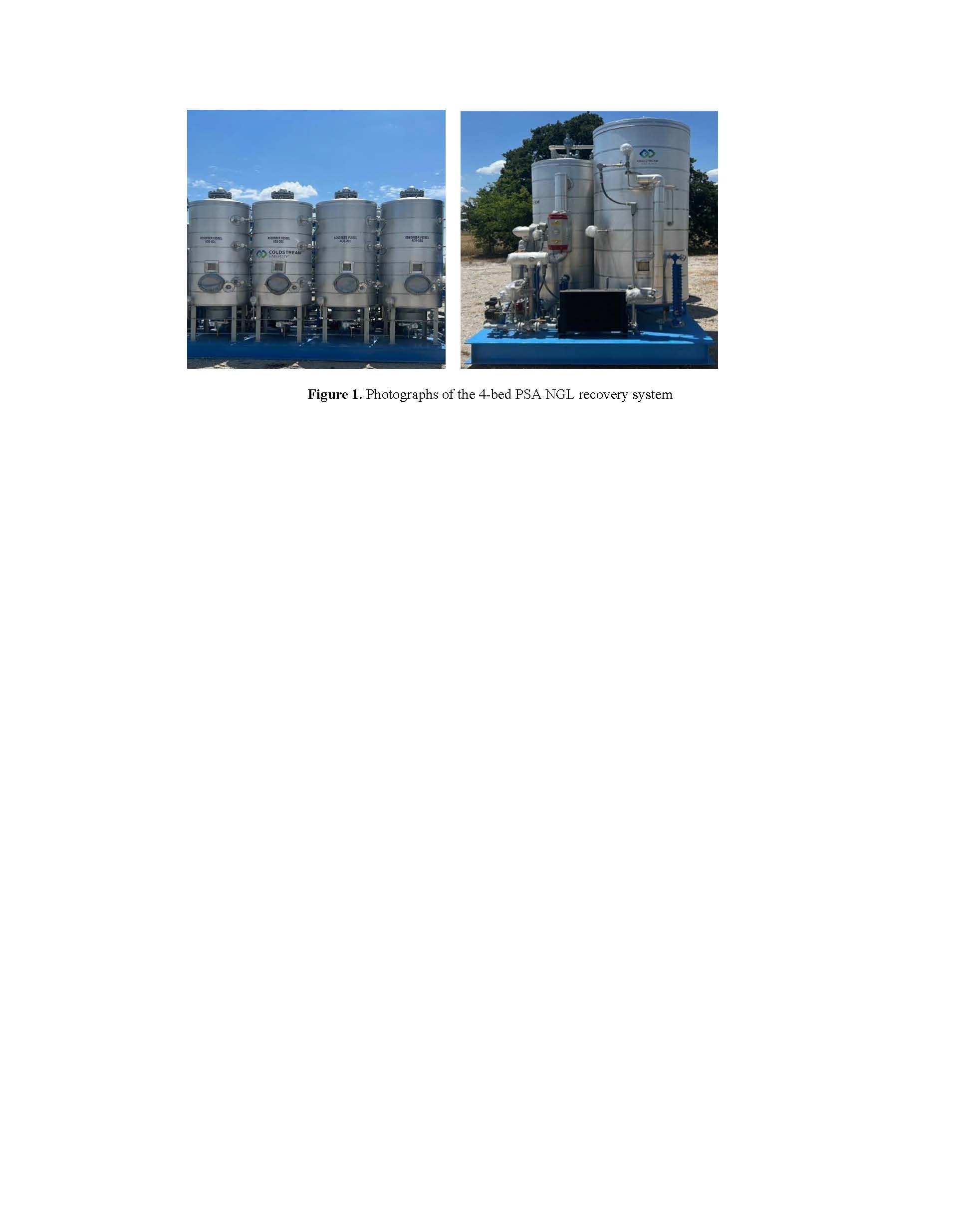
Therefore, the objective of this project was to develop a PSA system that could handle lower concentrations of C1 in the feed and higher GHVs, while producing a light product with a GHV below 1,100 Btu/scf and with a high recovery of NGLs. This objective was accomplished through PSA process simulation coupled with multi-bed bench-scale experimentation and culminating with pilot-scale and full-scale demonstrations in the field. The 4-bed PSA pilot plant is shown in Figure 1. This presentation will discuss the path to commercialization from an academic point of view. The focus will be on PSA process simulations compared to multi-bed bench scale PSA experimentation and pilot- and commercial-scale operations. Process flexibility in terms of fuel quality and the impact of this new PSA technology on reduced VOC emissions during combustion will also be discussed.
References
[1] Ho et al., US Patent 11,872,518 (2024).