2025 AIChE Annual Meeting
(696b) N-Type Conducting Polymers as New Materials for Ultrasensitive Hydrogen Detection
Authors
These limitations are largely due to the semiconductor layer. Metal oxide semiconductors (MOS) are the industry standard due to their large signal amplification and low limits of detection. However, their sluggish kinetics and high humidity sensitivity require operation at high temperatures, leading to high energy consumption and potential ignition risk. In contrast, carbon nanomaterials function at room temperature in humid conditions, but generally exhibit lower sensitivity.
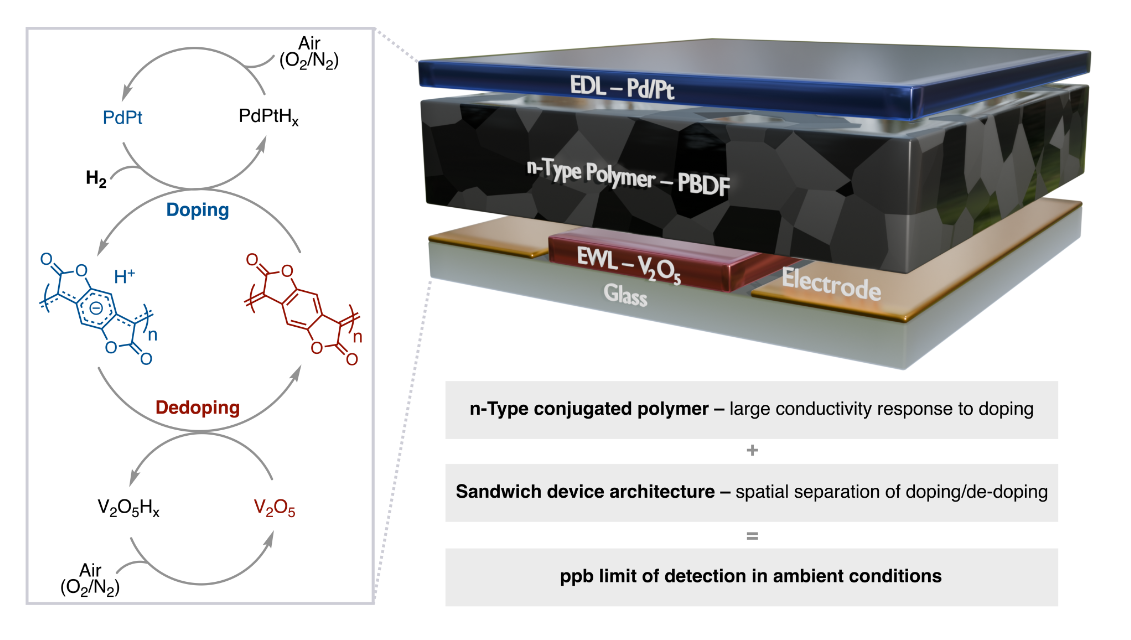
To address these deficiencies, we introduce n-type conducting polymers as a new scaffold for hydrogen sensing that combines the benefits of both material classes. Their high electron affinity and large change in conductivity upon doping imparts the high sensitivity of MOS devices, while the organic, relatively hydrophobic backbone enhances humidity tolerance. To achieve rapid kinetics at room temperature, we develop a new layered device architecture, where the polymer sits between an electron rich Pd/Pt layer and an electron deficient vanadium oxide layer. By decoupling the doping and de-doping processes to two spatially separated metal layers, we achieve parts per billion limits of detection at room temperature in wet and dry air. By leveraging this new material and device configuration, we realize state-of-the-art hydrogen sensing via fabrication methods that are cheap, simple, and commercially viable.