2025 AIChE Annual Meeting
(430f) Multifunctional Nanocomposite Encapsulation for Chronic Operation of Soft, Implantable Electro-Ionic Polymer Actuators
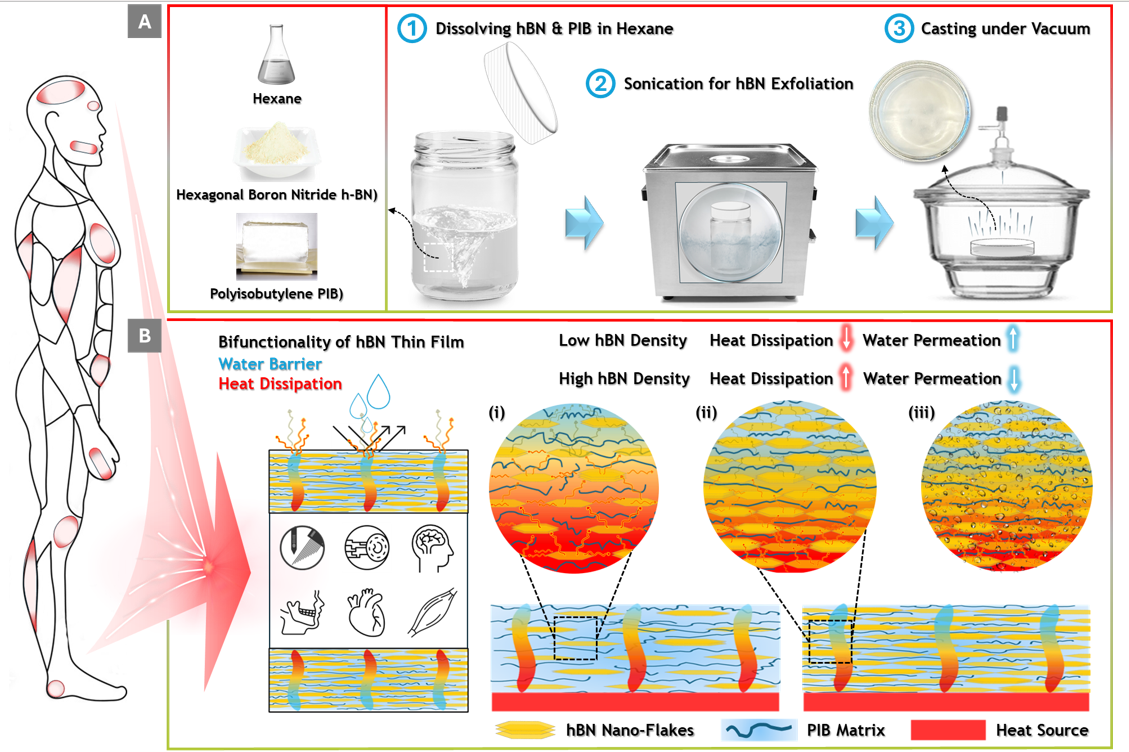
Electro-ionic polymer actuators (EIPAs) are an emerging class of soft prosthetics and robotics that have shown highly attractive applications such as artificial muscles and biosensors in recent decades. While significant progress has been made toward wearable and short-term biomedical applications, achieving long-term in-vivo operation remains a critical challenge. Key limitations include environmental degradation and heat dissipation during operation. In this work, we present a novel multifunctional encapsulation strategy using biocompatible polyisobutylene (PIB) nanocomposites. The encapsulation is engineered to act as both an effective water barrier and a thermal management layer. The actuator structure consists of an electrolyte-filled porous PVDF-co-HFP membrane, sandwiched between conductive PEDOT: PSS electrodes. This assembly is further encapsulated with a 7 μm thin PIB composite layer, infused with thermally conductive nanoparticles. The nanocomposite encapsulation achieves exceptional water vapor barrier performance, with a WVTR of 610 mg·m⁻²·day⁻¹, a value approximately 400 times lower than that of comparable encapsulants. At the same time, it enhances heat dissipation (0.74 Wm⁻¹ K⁻¹), helping to mitigate thermal hot spots during operation. To assess long-term durability, actuators were tested in various physiological environments, including deionized water, phosphate-buffered saline (PBS), and simulated oceanic conditions. Remarkably, the PIB-encapsulated actuator maintained stable performance over 100,000 actuation cycles in PBS, demonstrating excellent reliability and robustness. Electromechanical tests revealed substantial bending displacements under both AC and DC voltages (0.1–3.5 V) and across frequencies from 0.1 to 10 Hz. These results highlight the actuator’s responsiveness and thermal stability. Our findings demonstrate that PIB nanocomposite-encapsulated EIPAs are strong candidates for chronically implanted biomedical devices. They can operate reliably over extended therapeutic timescales, while addressing both moisture ingress and heat dissipation challenges.