2025 AIChE Annual Meeting
(573f) Multi-Scale Property Prediction and Design of Perovskites Using Nested Autoencoders
Authors
Rigoberto Hernandez, Georgia Institute of Technology
Advancements in simulation and
experimental characterization have allowed us
to predict and characterize material properties
across a wide range of spatial and
temporal length scales.
Often data-driven material property prediction models
learn from datasets confined to the scales
the data was generated from.
However, the search for novel materials is inherently
a multi-scale and multi-objective problem.
Here we introduce a novel neural network architecture and
training scheme called Nested Autoencoders [1]
to learn from disparate data sources that characterize
material properties at different scales (multi scale) and
with varying degrees of fidelity (multi fidelity)
to inform and optimize for properties at the engineering scales.
We demonstrate the efficacy of this approach to
(1) predict and optimize the power conversion efficiencies (PCE) of
metal halide perovskites (MHP)
(2) predict and optimize for bandgaps,
specific surface area and
crystallite size of perovskite oxides
for enhanced hydrogen production rates.
The method involves first partitioning the multi fidelity
datasets into subsets based on the scale the
descriptors are measured from.
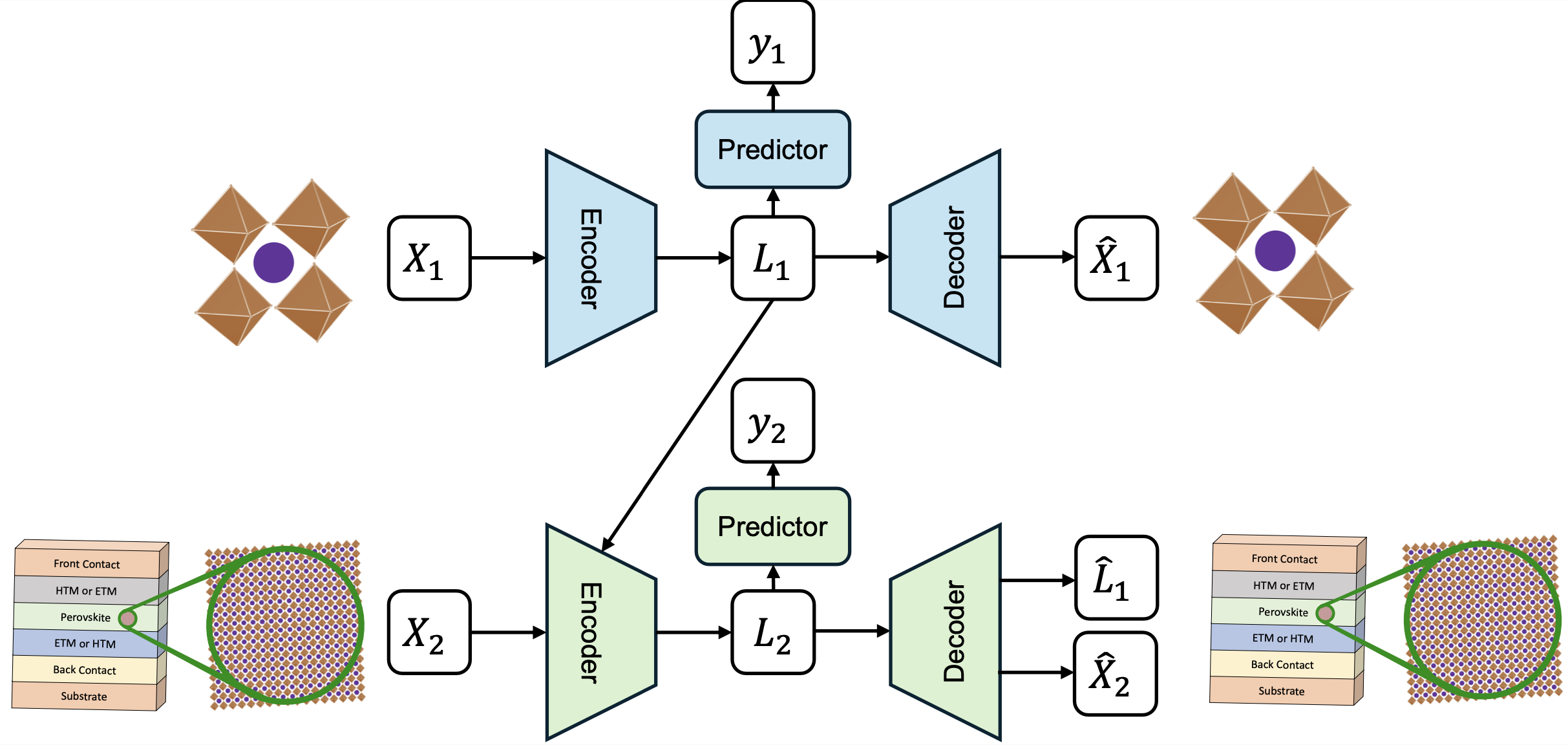
In the figure, X1 and X2 indicate
the small and large scale descriptors respectively.
The autoencoder reduces X1 to a low dimension embedding (L1)
which is jointly optimized to predict y1 and
reconstruct X1
through the predictor and
decoder neural network respectively.
To predict y2 which is the property
measured at a larger scale,
we feed the next autoencoder with the
optimized latents (L1) and
descriptor subset (X2) to
create a new low dimension embedding (L2).
Unlike L1, L2 is jointly optimized to
predict y2,
to reconstruct L1 and
to reconstruct X2.
This transfer of information
across the small to the large scale is why we
refer to this architecture as Nested Autoencoders.
We compared our results against models that
ignore scale hierarchy in datasets
and observed NestedAE shows improved
prediction capabilities [1].
We envision that this approach will be useful for
multi-scale material property optimization, and
will enable the completion of
multi-scale material datasets with missing
descriptor values.
[1] Thota, N.; Priyadarshini, M. S.; Hernandez, R. NestedAE: Interpretable Nested Autoencoders for Multi-Scale Materials Characterization. Mater. Horiz. 2024, 11 (3), 700–707.