2025 AIChE Annual Meeting
(394p) Multi-Agent Llms for Sustainable Operational Decision Making
Industry-Inspired Case Study and Multi-Agent LLM Framework
An effort to make the petrochemical industry more sustainable consisting of a network of four interconnected Gas-Oil Separation Plants (GOSPs), linked via swing pipelines, built on top of the work by Bahamdan et al. [3] serves as the study’s testbed. Each facility separates crude oil, associated gas, and water, incurring significant emissions and operating expenses (OPEX) primarily due to energy-intensive rotating equipment.
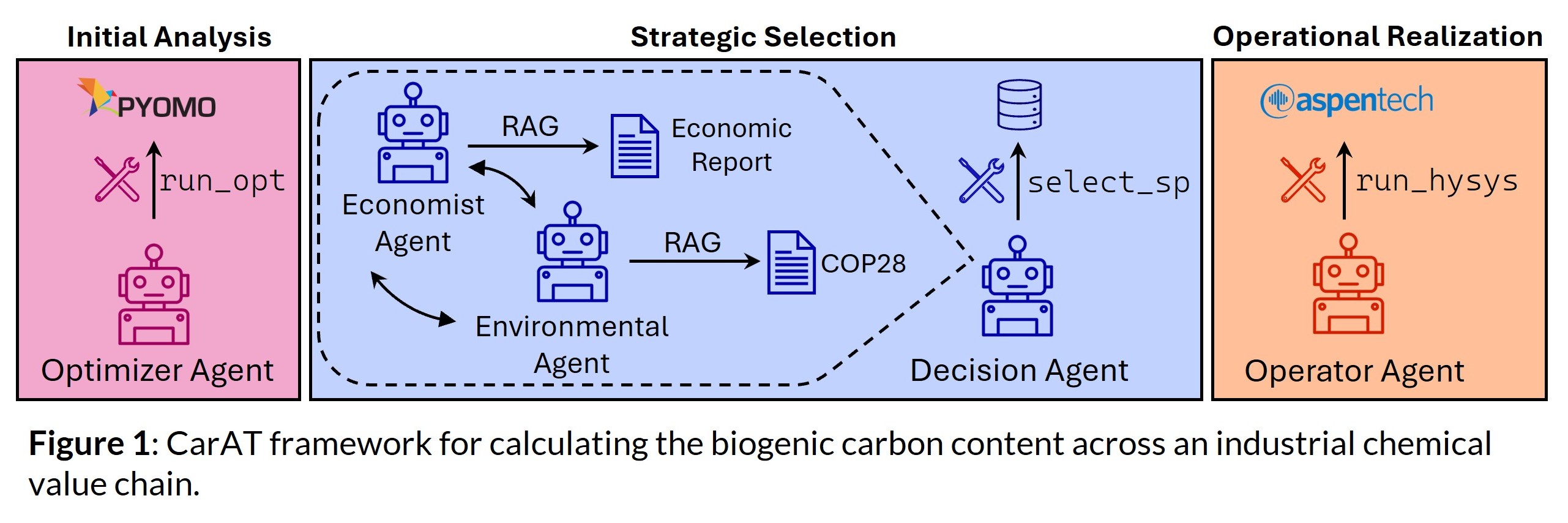
We developed a multi-agent LLM framework aligned with a three-stage decision process reflecting an industrially realistic workflow: Initial Analysis, Strategic Selection, and Operational Realization. During the Initial Analysis stage, the Optimization Agent gathers key input parameters (e.g., feed rates, target capacities) and executes a Pyomo-based multi-objective optimization, generating a Pareto front capturing trade-offs between cost and emissions. In the Strategic Selection stage, Economic and Environmental Agents debate setpoint selection from the Pareto front, advocating for cost minimization and emissions reduction, respectively. Using Retrieval-Augmented Generation (RAG) [4], a method allowing agents to reference external policies (e.g., COP28 directives [5]), they strengthen their arguments. Subsequently, the Decision Agent selects the optimal setpoint based on current operational and sustainability priorities. Finally, in the Operational Realization stage, the Operator Agent validates and implements the selected setpoint through high-fidelity HYSYS simulations, ensuring operational feasibility by confirming stream values, OPEX, and emissions. The LLM models used were variants of the open-source Llama 3.1 8B [6].
Key Results: Adaptive Decision-Making in Response to Evolving Constraints
In the base case scenario, the Decision Agent prioritized sustainability objectives, selecting low-emission setpoints that resulted in higher OPEX. When the Economic Agent was provided with a managerial directive imposing a cost limit, the workflow adapted accordingly, finding a balanced solution that maintained emissions considerations while ensuring costs remained within the specified threshold. Across ten trials on an RTX 3060 GPU, the agentic workflow achieved an average runtime under 80 seconds, enabling near-real-time scenario analysis. Structured debate transcripts enable operators to audit the decision-making process, providing transparency into how trade-offs were negotiated.
Impact and Future Work
This study demonstrates how multi-agent LLMs can integrate hierarchical operational decision-making in PSE contexts, balancing sustainability with economic demands. By simulating realistic negotiations among specialized agents, the proposed system flexibly adapts to emerging constraints, such as stricter emission targets or shifting budgetary conditions, maintaining transparency and auditability. Given the modular structure of the developed framework, it holds promise for generalization to broader industrial contexts, including petrochemicals, biomanufacturing, and fine chemicals. Future developments will include additional agent roles (e.g., regulatory, safety), dynamically updated compliance documents, and mechanisms for human oversight, ensuring safe, transparent, and ethical adoption of LLM-driven automation.
By integrating hierarchical decision-making through multi-agent LLM frameworks, this research probes into the vision of fully automated plants, where intelligent, AI-enhanced decision-making supports sustainable industrial practices.
References
[1] Puigjaner, L., Laínez, J.M. and Reklaitis, G.V. (2013) ‘Process Systems Engineering, 8. Plant Operation, Integration, Planning, Scheduling, and Supply Chain’, in Ullmann's Encyclopedia of Industrial Chemistry. doi: 10.1002/14356007.o22_o12.
[2] Guo, T. et al. (2024) ‘Large Language Model based Multi-Agents: A Survey of Progress and Challenges’, arXiv preprint, arXiv:2402.01680. doi: 10.48550/arXiv.2402.01680.
[3] Bahamdan, A., Shah, N. and del Rio-Chanona, A. (2024) ‘Surrogate Based Mixed Integer Linear Programming Model for Decarbonization of an Integrated Gas-Oil Separation Network’, in Manenti, F. and Reklaitis, G.V. (eds.) Computer Aided Chemical Engineering, Volume 53: 34th European Symposium on Computer Aided Process Engineering / 15th International Symposium on Process Systems Engineering. Elsevier, pp. 2209–2214. doi: 10.1016/B978-0-443-28824-1.50369-0.
[4] Lewis, P. et al. (2020) ‘Retrieval-augmented generation for knowledge-intensive NLP tasks’, in Proceedings of the 34th International Conference on Neural Information Processing Systems (NIPS ’20). Red Hook, NY, USA: Curran Associates Inc., pp. 9459–9474.
[5] UNFCCC (2023) ‘Summary of Global Climate Action at COP 28’, United Nations Framework Convention on Climate Change. Available at: https://unfccc.int/documents/636485 (Accessed: 31 March 2025).
[6] Hugging Face (2024) ‘Llama-3-8B’, Hugging Face Repository. Available at: https://huggingface.co/Groq/Llama-3-Groq-8B-Tool-Use (Accessed: 31 March 2025).