2025 AIChE Annual Meeting
(478c) Movement of Neutral Molecules Under Electric Fields and Relevance to Rechargeable Batteries
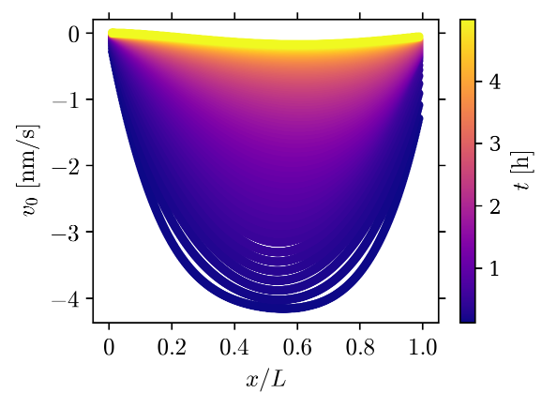
It is natural to focus on the movement of ions inside batteries due to an applied electric field. In this talk however, I will focus on the movement of neutral “solvent” molecules used to dissolve the ions. In our case, the solvent is a polymer. My journey toward the study of this effect began in 1979, when I learned about the continuity equation in the context of fluid mechanics as undergraduate student in chemical engineering. I will describe how the continuity equation changes in the presence of an applied electric field. Surprisingly, the field-induced velocity of long polymer chains is comparable to that of small molecule solvents and that of the ions. We will discuss approaches for measuring the field-induced velocity of solvent molecules; the velocity of ions is contained in current versus voltage measurements. Experimental data will be compared theoretical predictions without resorting to adjustable parameters. The efficacy of any electrochemical system depends on the fraction of energy used to move the working ion (lithium being the most popular ion these days). The energy used to move the solvent molecules is wasted, and thus important to understand, and it begins with the continuity equation. In addition to electrochemical experiments, I will insight into the molecular origin of polymer motion obtained by quasi-elastic neutron scattering (QENS). Polymer electrolytes have the potential to enable all-solid rechargeable batteries. I will conclude by describing the efforts to accomplish this at a start-up called Blue Current.