2025 AIChE Annual Meeting

(520g) Modeling Interfacial Phenomena of Liquid Metal Catalysts during Alkane Dehydrogenation Using Reactive Molecular Dynamics

Authors

Gunnar Sly - Presenter, Penn State University
Kathryn MacIntosh, Pennsylvania State University
Adri van Duin, Pennsylvania State University
Robert Rioux, Pennsylvania State University
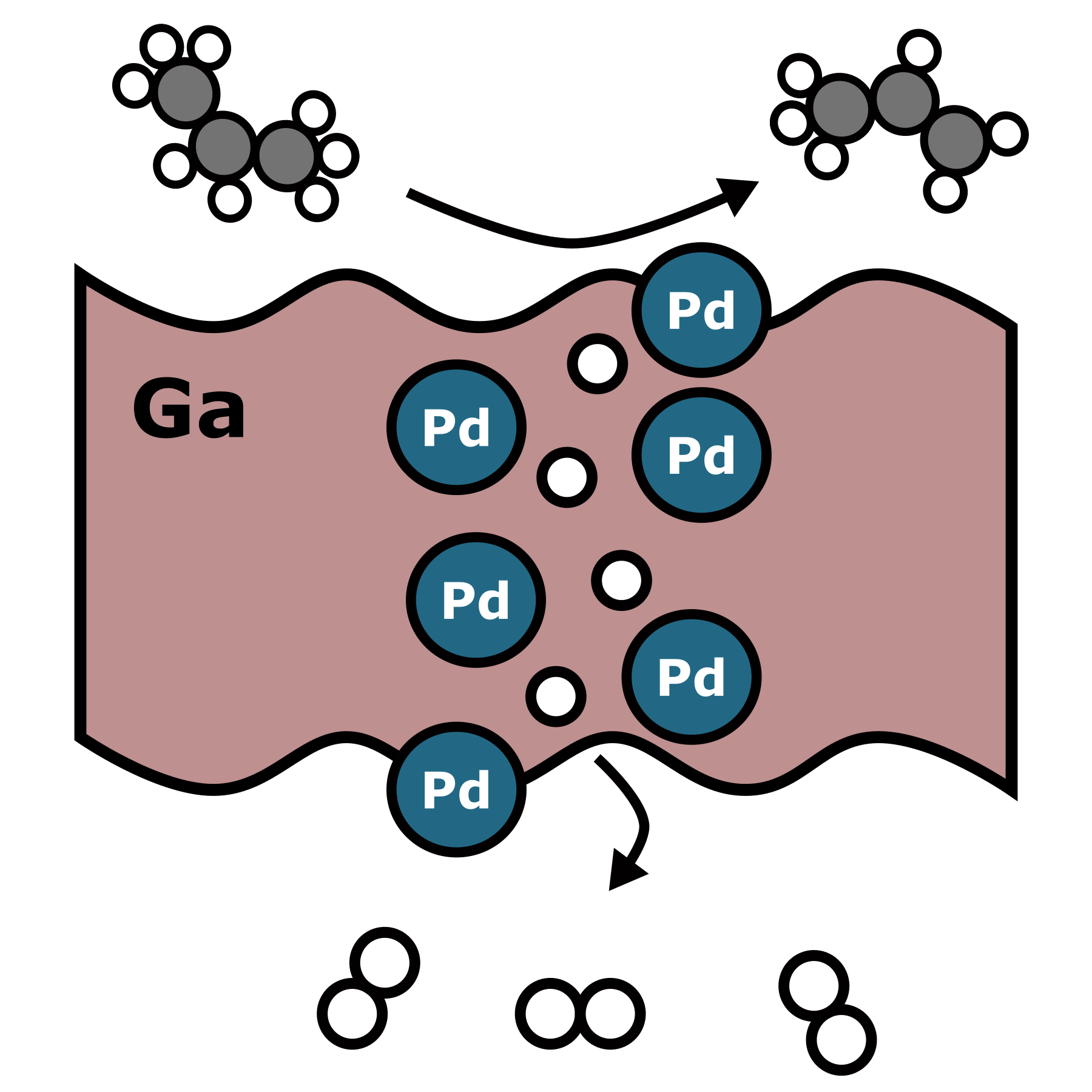
There is rising demand for active and stable propane dehydrogenation (PDH) catalysts due to increased availability of light alkanes derived from shale gas and higher costs of crude-oil used in steam cracking. High temperatures required for the endothermic PDH reaction deactivate traditional solid-state catalysts due to sintering and deep dehydrogenation to coke. Supported catalytically active liquid metal solutions (SCALMS) are an emerging class of materials in which active late transition metals are diluted in a fuseable liquid metal matrix. The insolubility of Cx species in the liquid matrix avoids coke formation. H2 permeability may permit PDH process intensification through selective product separation in catalytic membrane reactor configurations. The atomic structure of SCALMS, specifically PdGa, and the interactions with gaseous H2 and Cx species are challenging to determine experimentally due to non-crystalline surface structures. While density functional theory (DFT) is able to describe short-range-ordered materials, it cannot capture the dynamic structures of amorphous adsorbate-liquid interfaces. Alternatively, kinetic and transport phenomena can be observed over the required length and timescales using reactive molecular dynamics (RMD).

We present a ReaxFF-based investigation of the newly trained Pd-Ga-C-H system to quantify Pd speciation and interactions with co-fed hydrogen and C2-3 species within the liquid matrix. To ensure our model captures relevant molecular phenomenon, H2 uptake, H2 permeability, and H2-D2 exchange rates are measured across Pd-Ga compositional space for bulk, slab, and particle morphologies with comparison to experimental observations. Enhanced statistical sampling of equilibrium Pd-Ga-H phases is achieved using a hybrid grand canonical Monte Carlo/molecular dynamics (GC-MC/MD) framework. The segregation tendencies of Pd active sites induced by H & Cx reaction intermediates were quantified using GC-MC/MD through the introduction of surface intermediates. The complete description of Pd-Ga SCALMS ensembles under these reactive environments enables informed and interpretable experimental measurements in the absence of reliable/applicable characterization techniques.