2025 AIChE Annual Meeting
(391l) Modeling and Simulation of Batch Distillation in a Copper Still: Economic Assessment for Pisco Production
Authors
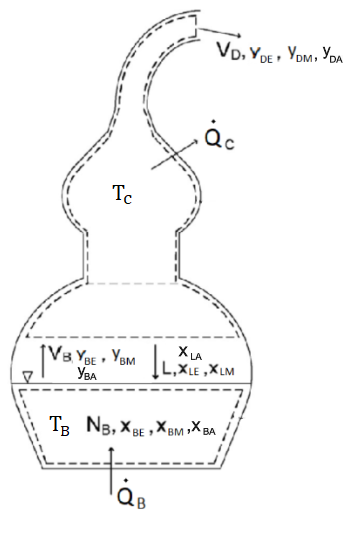
This study presents a mathematical model to simulate the batch distillation of a fermented must in a copper still, integrating mass and energy balances, phase equilibrium relations, and heat transfer dynamics. The system is modeled as a mixture of water, ethanol, methanol, and acetaldehyde, key components influencing distillate quality. The model incorporates non-ideal phase behavior using activity coefficient-based thermodynamic correlations to more accurately represent component volatilities. Differential equations governing vapor-liquid equilibrium and component separation are numerically solved in MATLAB, enabling the evaluation of how head cut strategies affect distillate composition. The model is qualitatively validated by comparing predicted trends with experimental data from the literature. Furthermore, a sensitivity analysis is performed by varying the ambient temperature and the heat flux supplied to the still. Additionally, an economic analysis compares the traditional distillation method, which employs a 1% v/v head cut, with the proposed approach, where the head percentage is determined through the model's analysis. This model not only describes the distillation process but also enables the refinement of the head cut strategy based on the initial composition of the must. The ability to predict distillate evolution could be integrated with real-time control systems to enhance process efficiency. By adjusting cut points dynamically, the model provides a foundation for automation and process optimization, reducing variability and improving regulatory compliance.
The results demonstrate that head cut requirements depend on must composition. At low levels, methanol and acetaldehyde remain within regulatory limits without a head cut, maximizing efficiency. At intermediate levels, a 0.5% v/v head cut ensures compliance while increasing Pisco yield by 3.4%. However, at high concentrations, even extensive head cuts fail to meet regulatory alignment, underscoring the need for fermentation control. The model accurately predicts the evolution of key compounds according to experimental data from the literature, with high acetaldehyde concentration in early fractions and methanol content increasing in later ones. Additionally, the results suggest that adjusting the heat flux can enhance process efficiency without compromising Pisco quality, while environmental factors such as ambient temperature have no significant impact on the distillation process or the final product composition. Beyond describing the process, this model establishes a framework for refining batch distillation through real-time adaptive control. By regulating distillation cuts, it ensures product consistency, reduces losses, and strengthens regulatory compliance. The proposed strategy boosts net present value (NPV) by 30.32%, highlighting its potential to increase the profitability and efficiency of artisanal Pisco production.