2025 AIChE Annual Meeting
(53b) Mobility of Solvated Cu+ Cations in Cu-Exchanged Zeolites Predicted By Machine Learning Accelerated Molecular Dynamics Simulations
Authors
Reisel Millan, Consejo Superior Investigaciones Cientificas CSIC
Rafael Gómez-Bombarelli, Massachusetts Institute of Technology
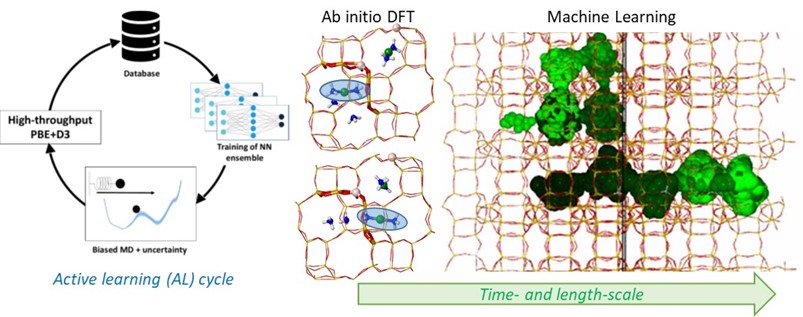
Cu-exchanged zeolites play a crucial role as redox catalyst for the abatement of nitrogen oxides (NO, NO2, N2O) emissions through the selective catalytic reduction reaction with NH3 (NH3-SCR-NOx reaction). Cu-CHA zeolite is the commercial catalyst used in diesel vehicles, and other zeolite topologies as AEI and LTA are being explored aiming to improve activity or long-term stability.The catalytic activity of Cu-CHA relies on the mobility of NH3-solvated Cu+ cations, and more specifically on the probability of finding two solvated Cu+(NH3)2 cations simultaneously in the same cavity, but the influence of framework topology (CHA, AEI or LTA) and composition (Si/Al ratio, Al distribution) on the mobility of Cu+ is not fully understood yet. Ab initio molecular dynamics (AIMD) simulations can provide quantitative atomistic insight on Cu+ mobility, but they are too computationally expensive to explore large length and time scales or diverse catalyst compositions. Machine learning has demonstrated broad applicability in materials science and heterogeneous catalysis, allowing to reach the accuracy of DFT methods at a fraction of the computational cost. We report a machine-learning interatomic potential that accurately reproduces ab initio results allowing multi-nanosecond simulations and diverse chemical compositions of Cu-exchanged zeolite catalysts (see Figure). The simulations performed for Cu-CHA, Cu-AEI and Cu-LTA zeolites show that the free energy barriers for the diffusion of Cu+(NH3)2 cations through the 8R windows connecting adjacent cages depend on the shape of the window and on the amount and distribution of Al in the 8R windows, while the probability of having pairs of Cu+(NH3)2 cations in the same cage increases with overall Al content in CHA and LTA, and also on the local distribution of Al in the less symmetrical AEI cage (JACS Au 2021, 1, 1778; ACS Central Sci. 2023, 9, 2040).