2025 AIChE Annual Meeting
(291h) Microwave-Assisted Regeneration of Amine-Functionalized Sorbent for Direct Air Capture: Comparative performance of Fluidized and Packed Beds
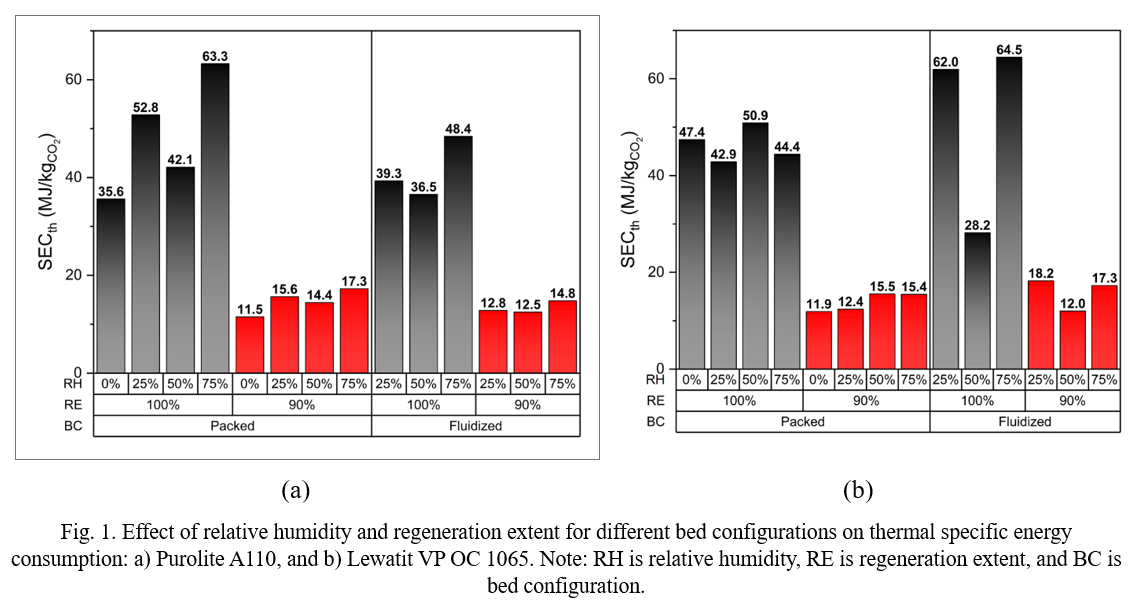
Experiments were performed under dry and humid conditions using a custom-built mono-mode microwave system (MicroChem, Sairem Corp.) equipped with a solid-state generator capable of frequency modulation between 2.4–2.5 GHz and adjustable power up to 200 W. This work investigated the feasibility of MWSA-based DAC in fluidized-bed and packed bed configurations using amine-based sorbents. Microwave absorption efficiencies of 41.2% and 37.6% were achieved for Purolite and Lewatit, respectively, with regeneration efficiencies exceeding 83%. Purolite exhibited higher CO2 uptake and up to 23% lower thermal specific energy consumption (SECth) than Lewatit, though with slightly lower CO2 productivity. The 90% partial regeneration strategy provided an optimal trade-off (CO2 productivity vs. SECth) enhancing CO2 productivity by up to 8% while reducing SECth by 68%, as shown in Fig. 1. Comparing bed configurations, packed beds achieved greater CO2 uptake, whereas fluidized beds reduced SECth by up to 15% and increased CO2 productivity by 38% for Purolite and 46% for Lewatit. Overall, these results highlight the potential of microwave-assisted regeneration in fluidized-bed DAC systems as an energy-efficient and scalable pathway for carbon removal.
REFERENCES
[1] E.S. Sanz-Pérez, C.R. Murdock, S.A. Didas, C.W. Jones, Direct Capture of CO2 from Ambient Air, Chemical Reviews 116(19) (2016) 11840-11876. https://doi.org/10.1021/acs.chemrev.6b00173.
[2] C. Intergovernmental Panel on Climate, Global Warming of 1.5°C: IPCC Special Report on Impacts of Global Warming of 1.5°C above Pre-industrial Levels in Context of Strengthening Response to Climate Change, Sustainable Development, and Efforts to Eradicate Poverty, Cambridge University Press, Cambridge, 2022. https://doi.org/DOI: 10.1017/9781009157940.
[3] X. Zhu, T. Ge, F. Yang, R. Wang, Design of steam-assisted temperature vacuum-swing adsorption processes for efficient CO2 capture from ambient air, Renewable and Sustainable Energy Reviews 137 (2021) 110651. https://doi.org/https://doi.org/10.1016/j.rser.2020.110651.
[4] M. Gholami, B. Verougstraete, R. Vanoudenhoven, G.V. Baron, T. Van Assche, J.F.M. Denayer, Induction heating as an alternative electrified heating method for carbon capture process, Chemical Engineering Journal 431 (2022) 133380. https://doi.org/https://doi.org/10.1016/j.cej.2021.133380.
[5] C.A. Grande, R.P.L. Ribeiro, E.L.G. Oliveira, A.E. Rodrigues, Electric swing adsorption as emerging CO2 capture technique, Energy Procedia 1(1) (2009) 1219-1225. https://doi.org/https://doi.org/10.1016/j.egypro.2009.01.160.
[6] T.N. van Schagen, P.J. van der Wal, D.W.F. Brilman, Development of a novel, through-flow microwave-based regenerator for sorbent-based direct air capture, Chemical Engineering Journal Advances 9 (2022) 100187. https://doi.org/https://doi.org/10.1016/j.ceja.2021.100187.
[7] M. Erguvan, R. Boylu, M. Strobel, S. Amini, An experimental study on microwave-assisted direct air capture of CO2 under fluidized bed conditions, Sustainable Energy & Fuels 9(5) (2025) 1247-1267. https://doi.org/10.1039/D4SE01784F.