2025 AIChE Annual Meeting
Microtubule Foams for Physical Capture and Recovery of Microplastics
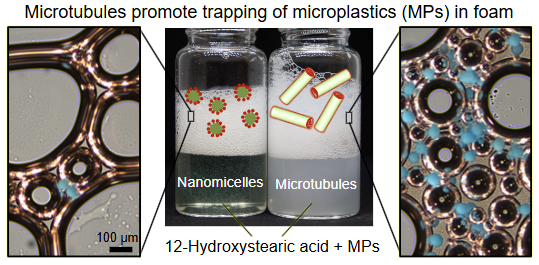
Microplastics (MPs) are pervasive environmental contaminants whose removal from water remains a major challenge due to their small size, chemical diversity, and dynamic surface properties arising from environmental aging. Here, we present a foam-based separation method that physically traps MPs in the foam phase using microtubular assemblies of 12-hydroxystearic acid. These foams are stabilized by anisotropic fatty acid microtubules formed in the presence of ethanolamine, which jam within the foam channels and suppress fluid drainage enhancing MP retention and foam stability. MPs of different sizes, polymer compositions including polystyrene, polypropylene, polyethylene terephthalate, and polytetrafluoroethylene, and weathering states were retained in the foam phase without requiring chemical modification or reliance on chemical interactions between the fatty acid and MPs. Thermally induced transition of the fatty acid microtubules into nanomicelles above the characteristic phase transition temperature (35 °C) enables controlled foam collapse and recovery of trapped MPs. The cumulative removal efficiency exceeds 85% through multiple foaming cycles and matches predictions from a probabilistic retention model. This work shows that foams can provide a simple platform to trap MPs, thus providing a new physical-removal strategy that does not rely on the particles’ chemistry.