2025 AIChE Annual Meeting
(600c) Microstructure & Rheology of of Thermoreversible Colloidal Gels By 4D-Rheosans
Authors
Norman Wagner - Presenter, University of Delaware
Thaddeus Egnaczyk, Bucknell University
Khushboo Suman, IIT Madras
Mukund Kabra, University of Delaware
Quent Hartt, University of Delaware
Christopher Neal, Oak Ridge National Lab
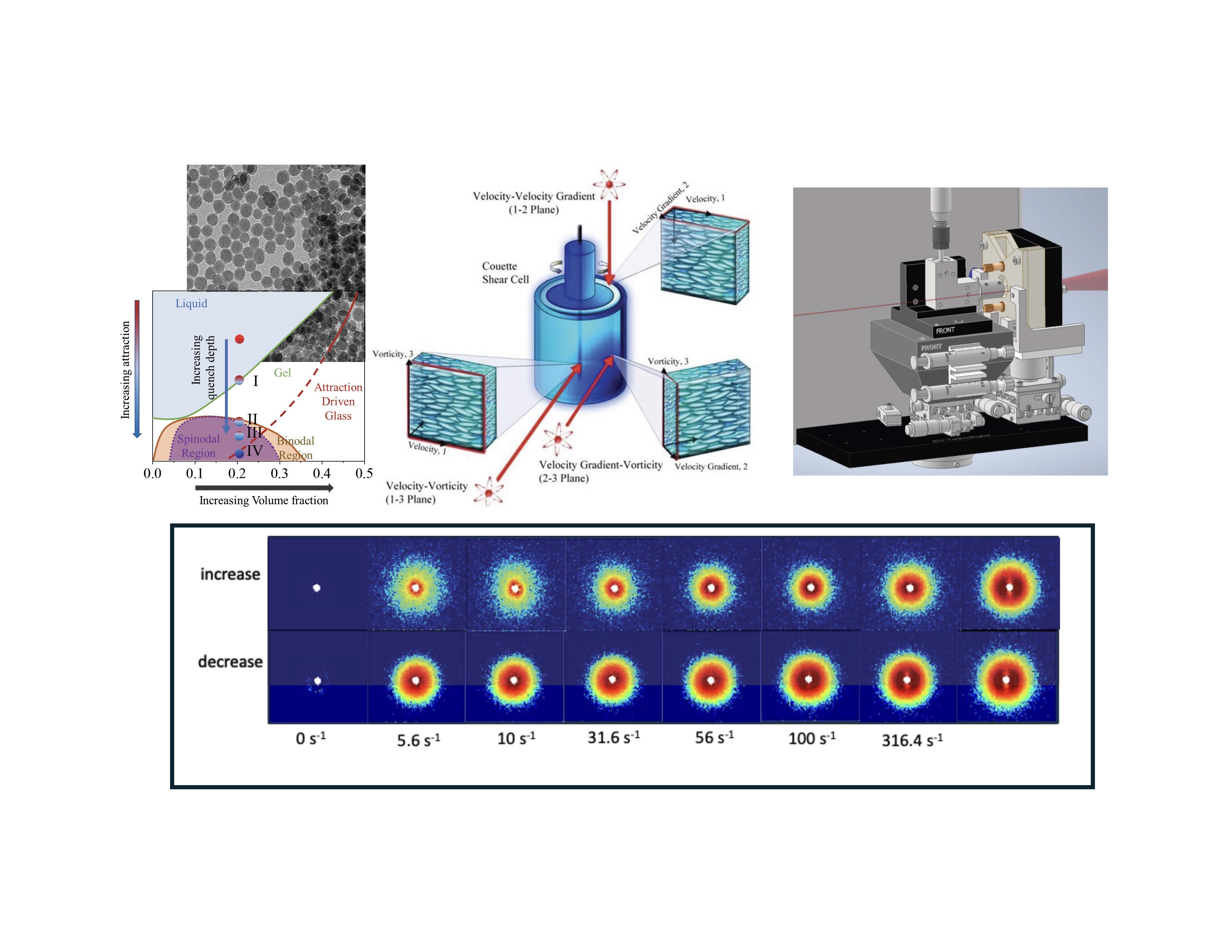
Fundamental questions concerning the interplay between particle interactions, dynamical arrest and phase behavior are addressed by rheology and neutron scattering measurements on a model, thermoreversible, colloidal adhesive hard sphere (AHS) suspension. In contrast to monotonic aging observed for shallow quenches, deeper quenching leads to an anomalous rheological behavior in the form of a reproducible drop in shear modulus, which has been attributed to arrested phase separation. To provide a mechanistic understanding, small angle neutron scattering measurements under rheological shear flow (Rheo-SANS) is used to interrogate the microstructure on the particle scale. Upon sudden reduction in temperature from a liquid state to gel state, shear-induced structural anisotropy is observed as butterfly scattering patterns and quantified in terms of alignment factor. Upon increasing the extent of thermal quench, the increased strength of interparticle attraction increases the viscosity as well as the degree of shear-induced anisotropy. SANS measurements of colloidal suspension as a function of time during various thermal quench is characterized in terms of an effective interaction strength and a Mason number. In this manner, the interplay of gelation, phase separation, and glass formation is explored where shear and large amplitude oscillatory shear (LAOS) provide a means to explore the nonequilibrium nature of these transitions as well as the effects of shear rejuvenation. Finally, a new 4D RheoSANS instrument is used to uniquely probe structure transitions in the plane of shear in situ with shear rheology. This study of the flow behavior upon thermal quench in model colloidal gel system is of both fundamental importance and industrial relevance in understanding how shear affects the flow behavior of colloidal gels. Connections showing the applicability of the learnings from this study to improve the processing of commercial materials, such as geopolymers for construction materials, will be presented.