2025 AIChE Annual Meeting
(332e) Microdynamic Insights into Gelation in Dilute Colloidal Systems
Authors
We investigate colloidal cluster gels composed of particles with diameters ranging from 0.1 to 0.5 µm and volume fractions in the range 10-2 to 10-1. Gelation is induced by the addition of divalent salt in the concentration range 20– 60 mM, which is expected to deepen the attractive potential well, resulting in a proportional increase in k0 . Within the Krall-Weitz framework, the elastic modulus G′ is related to microstructural parameters as follows:
G'= a-1k0Φ(4.1/(3-df)) (1)
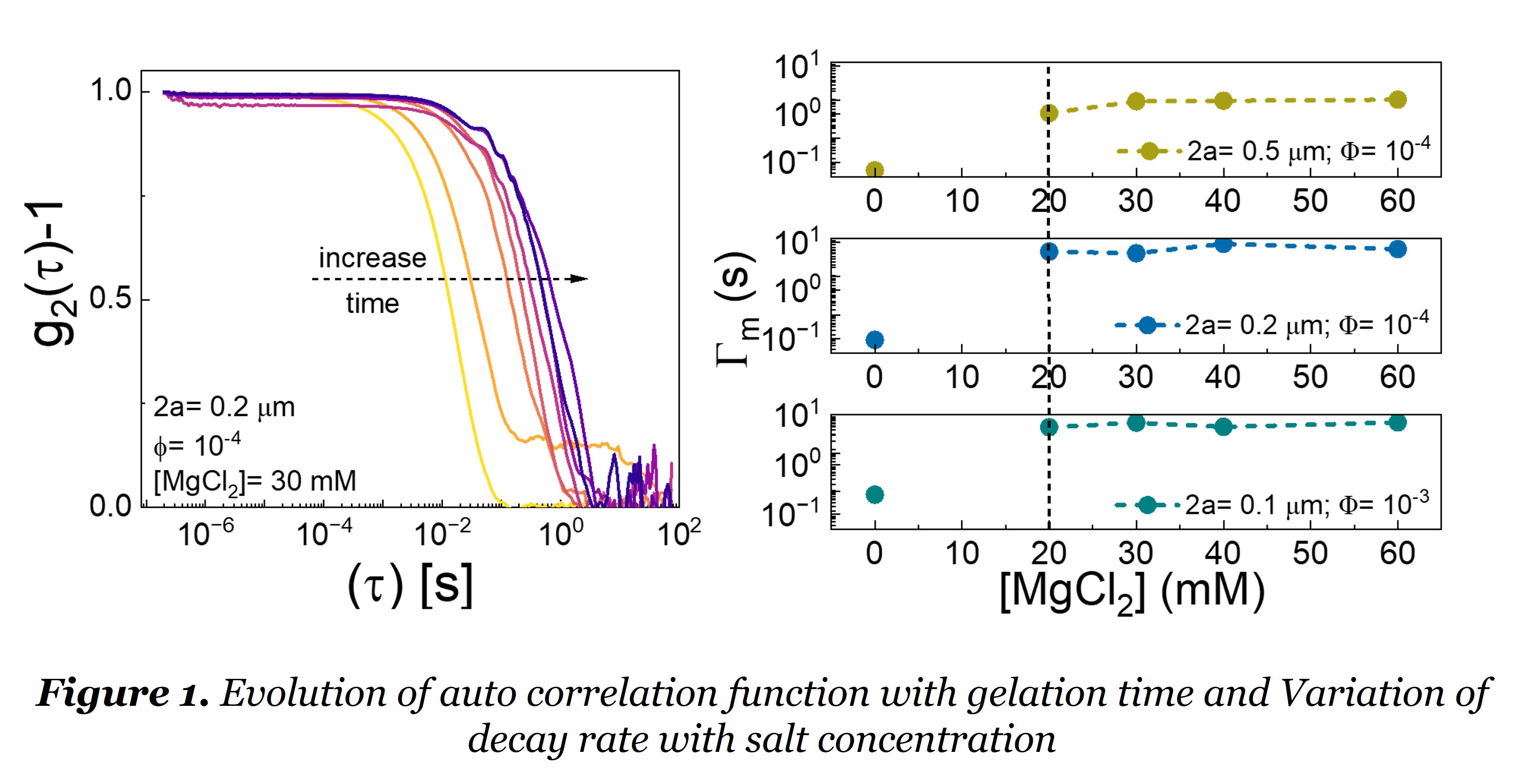
However, analysis of DLS intensity autocorrelation functions reveals that variations in salt concentration result in less than 5% change in the characteristic relaxation rate (Γ) (Figure 1), which is inversely related to the bond stiffness (Γ∝ 1/k0). This observation suggests negligible variation in k0 , indicating that bond stiffness remains largely unaffected by salt concentration in this regime.
We hypothesize that in the diffusion-limited cluster aggregation (DLCA) regime, where electrostatic interactions are fully screened, the bond constant is primarily determined by the Hamaker constant. The Hamaker constant, being governed by the intrinsic molecular properties of the colloidal particles, is largely insensitive to ionic strength once electrostatic repulsions are suppressed. Consequently, based on equation (1), we propose that the elasticity of dilute colloidal sphere gels follows a universal behavior. To support this, we compile literature data across a wide range of particle chemistries and sizes. When plotted as the particle size-normalized modulus (G'a) vs. ϕ, the data collapse onto a master curve in the dilute regime (ϕ < 0.1). This curve exhibits a power-law scaling of G′∼ϕ³.⁵, consistent with theoretical predictions.
These findings underscore the universal nature of elasticity in dilute sphere gels and call for a critical reassessment of the role of inter-particle bond strength in such systems. The results highlight the need for alternative strategies to modulate gel elasticity in the dilute limit.