2025 AIChE Annual Meeting
(232d) Membrane Crystallizer
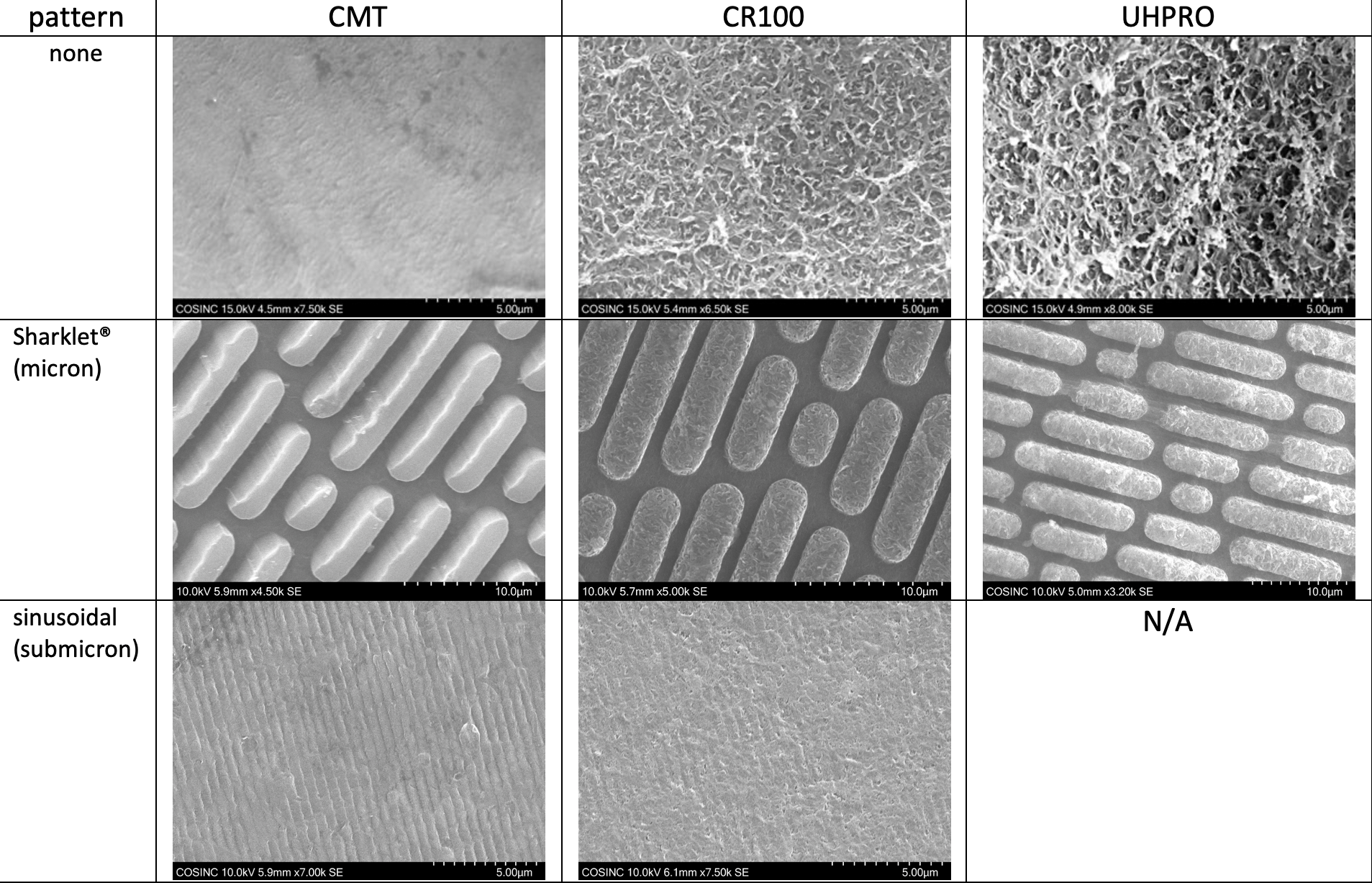
We will present lab-scale results from surface patterned, commercial, thin film composite (TFC) membranes. Surface patterning has been accomplished using both submicron and micron sized regular surface features (see Figure). The ability to pattern commercial TFCs with good fidelity, submicron features remains challenging.
Our scaling-resistance testing is performed with a closed circuit reverse osmosis (CCRO) methodology that starts with a supersaturated feed and continuously concentrates it and recirculates the growing crystals. Our figure-of-merit is productivity before flux "crash" due to surface deposition of crystals. We have found that micron-sized patterns are a promising approach and that the orientation with respect to the crossflow makes a difference.
This work builds from Professor Cohen's long-term contributions and study of scaling and crystallization during desalination. Consequently, we have also applied "homemade" visualization approaches to help us validate what we measure with what can be seen.
Finally, we will also present how a "membrane crystallizer" can be part of an accelerated desupersaturation design by using a static inline mixer to more efficiently grow crystals. Illustrative results from small pilot tests will be provided.