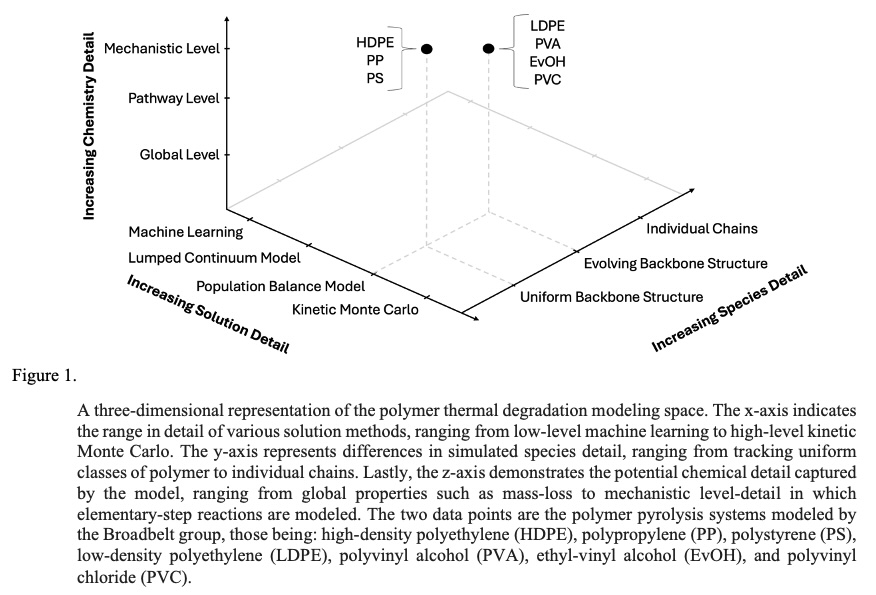
One challenge facing the construction of mechanistic models for polymer deconstruction is the complexity associated with the system size. A polymer melt consists of chains with a distribution of lengths, often with a range of 105-106, each capable of undergoing thousands of reactions. As chains degrade, the growing number of unique species makes model solution intractable. To address this limitation, the method of moments (MoM) is invoked, as the technique can capture a high level of chemical detail at low computational cost. In practice, the MoM is imposed on a population balance to track the impact elementary-step reactions have on the length distribution of sub-classes of chains. These sub-classes are defined by their functionality while the concentration of reactive moieties and branches can be quantified from evolving probabilities. Additionally, reaction rates have both a temperature and structural dependence, as the models utilize rate coefficients in the Arrhenius form with activation barriers calculated using the Evans-Polanyi relationship.
To date, the Broadbelt group has constructed mechanistic models for several polymer pyrolysis systems, establishing a methodology for simulating these complex systems. Early work focused on establishing a method for modeling linear homopolymers such as high-density polyethylene, polypropylene, and polystyrene. These works demonstrated the ability of the methodology to predict high-value product yields, as well as to capture the evolution of polymer properties such as number and weight average molecular weight. Recently, the group has focused on addressing increasingly complex systems, such as chains with reactive functional groups (polyvinyl alcohol), non-linear polymers (low-density polyethylene), and co-polymers (ethyl-vinyl alcohol). To construct these models, novel techniques using probabilities were developed to track the evolution of moieties. This talk will highlight the applications of the MoM, demonstrate developments for capturing key polymer features, and illustrate the potential for future work in the field of polymer degradation modeling.