2025 AIChE Annual Meeting
(42c) Mechanistic Exploration and Kinetic Modeling through in-Silico Data Generation and Probabilistic Machine Learning Analysis
Authors
Xiao Li - Presenter, Sanofi
Yasser Jangjou, Sanofi
Colton Davis, Sanofi
Sven Jager, Sanofi
Indu Muthancheri, Sanofi
Andreas R. Rötheli, Sanofi
Antoine de Gombert, Sanofi
Reza Amirmoshiri, Sanofi
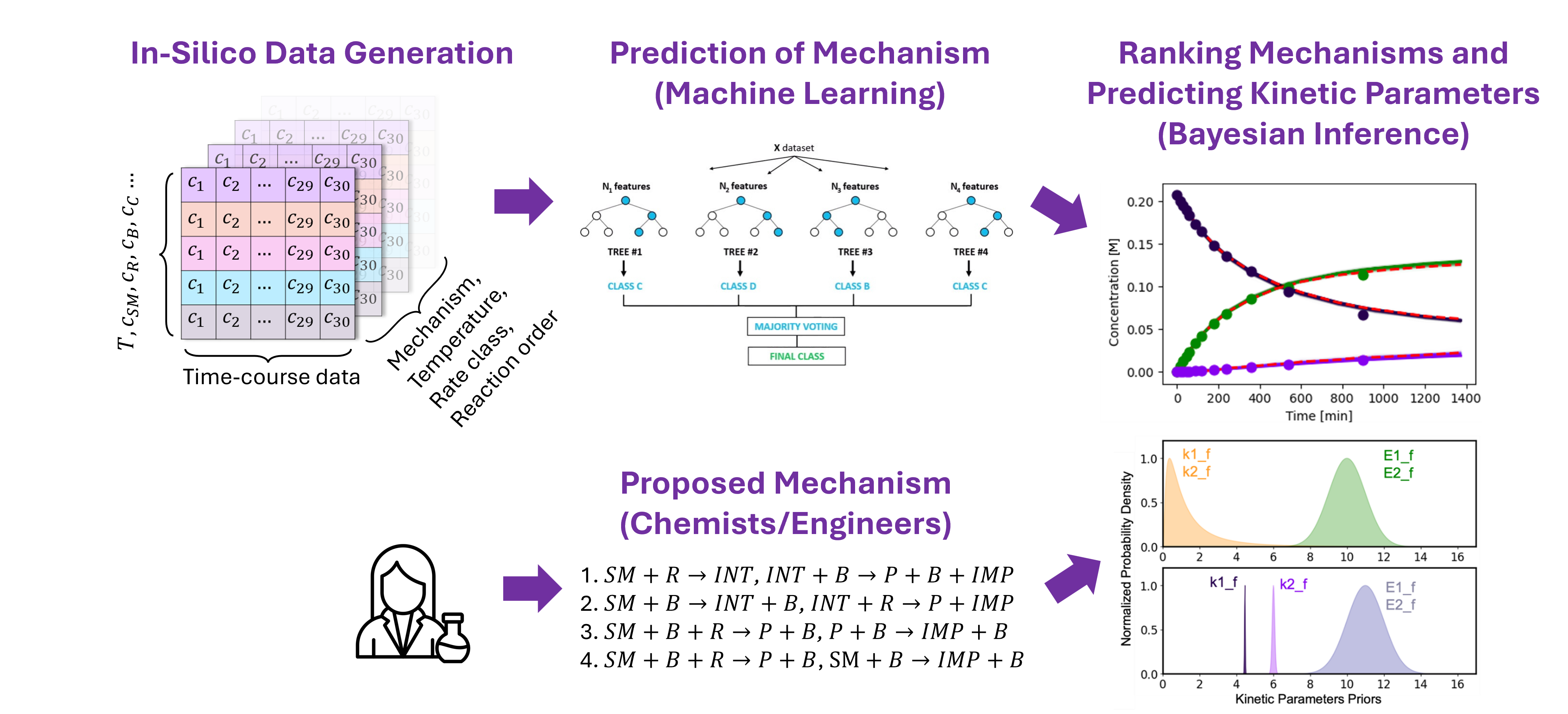
First-principles-based kinetic models are powerful tools for developing and optimizing chemical reactions. Capable of describing the transient behavior of reactions, these models are particularly enabling for designing, optimizing, and controlling processes in a fully digital fashion. Despite advancements in kinetic modeling methods, challenges persist due to resource-intensive experimentation, the need for chemistry and engineering expertise, and difficulties in quantifying uncertainties. This work presents a workflow and open-source Python package, the Sanofi Kinetic AI (SKAI) tool, that simplifies kinetic modeling. The proposed method democratizes kinetic hypothesis testing by leveraging Bayesian inference, allowing scientists to evaluate reaction pathways without repeated trial-and-error experimentation. To further enhancing accessibility, we incorporate a prompt-engineered large language model (LLM) that converts reaction descriptions into system equations. Additionally, pre-trained machine learning models, trained on in-silico time-course data, support hypothesis generation by providing data-driven assumptions about reaction pathways in low-data regimes. We validate this framework with two industrially relevant case studies involving series and parallel reactions, demonstrating its efficacy in pathway elucidation, kinetic modeling, and uncertainty quantification. The approach also integrates Model-Based Design of Experiments (MBDoE) and a closed-loop reaction optimization system, enabling seamless kinetic model development and optimization, the suggestion of new optimized experiments, and the automatic execution and validation of those experiments through automation tools. This provides a robust and accessible toolset for advancing kinetic modeling practices.